Track B · UPH
Upholstery & Fabric Cleaning Certification
The NISCR Upholstery & Fabric Cleaning Certification is a $199 online, self-paced course — 8 lessons (≈2.5 hours) with a 20-question exam; pass and download a verifiable certificate the same day, valid 2 years.
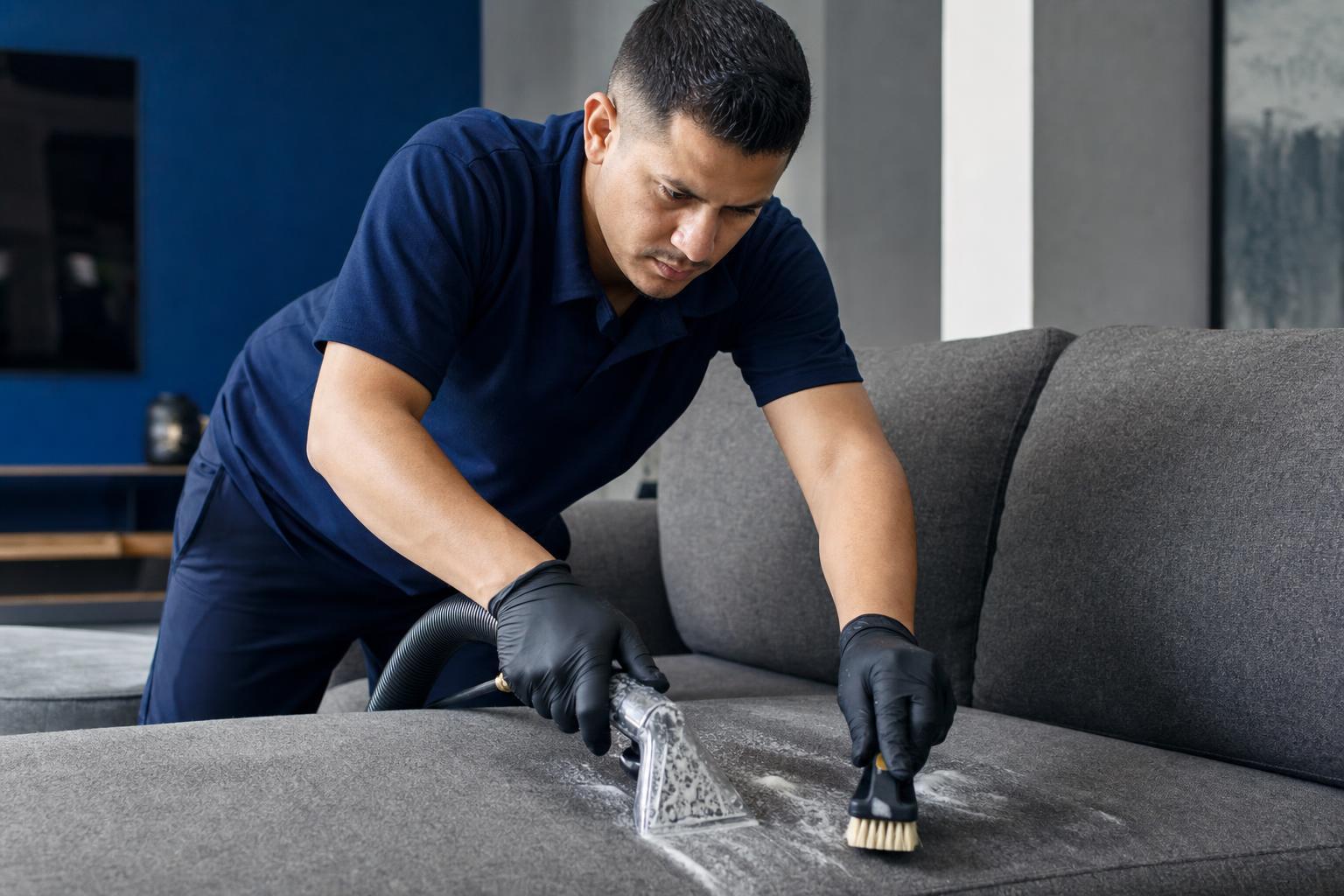
Master the fabric-safe process for cleaning and protecting upholstery and delicate textiles — fiber identification, colorfastness and pre-testing, and method selection — and prove your competence with a credential clients and furniture owners trust.
- Self-paced
- Instant certificate
- 2-year validity
- Format
- Online, self-paced
- Lessons
- 8 lessons
- Time
- ≈2.5 hours
- Exam
- 20 questions
- Pass mark
- 75% · retries
- Documents
- 3 included
- Certificate
- Same day
- Validity
- 2 years
Earning potential
How much can you earn?
Per upholstery job
$100–400
Add-on to a carpet job
high-margin upsell
Recurring fabric care
repeat seasonal revenue
Illustrative ranges — actual earnings vary by location, effort, and experience, and are not guaranteed.
Why it pays
Why get certified?
Sell the upgrade with confidence
Carpet customers add upholstery to the ticket when a tech can explain the fabric-safe method and back it with a credential.
Protect yourself from damage claims
Documented fiber identification and pre-testing show you followed a defensible standard before you ever wet a fabric.
Win premium and delicate work
Owners of silk, wool, and designer pieces hire the certified tech over the generalist who treats every cushion the same.
Build recurring accounts
Certification supports seasonal refresh and maintenance programs that turn one job into a repeat client.
Curriculum
Inside the Upholstery & Fabric Cleaning course
8 self-paced lessons, then a 20-question exam — 75% to pass, unlimited retries. Exam questions are drawn from a larger question pool, so every retry gets a fresh set.
- 1
Lesson 1: Fiber and Fabric Identification — Reading the Piece Before You Touch It
Every upholstery job begins with an identification, and everything that follows depends on getting it right. The fiber tells you what the fabric can survive; the construction tells you how it will behave under moisture and agitation; the manufacturer's cleaning code tells you what the maker is willing to stand behind. Misidentification — not bad chemistry, not bad equipment — is the leading cause of ruined pieces, and it is preventable with ten disciplined minutes before anything gets wet.
- 2
Lesson 2: Pre-Inspection and Pre-Testing — Earning the Right to Clean
The pre-inspection is where a professional either earns the job or protects themselves from it. Before you commit to a method or a price, you need three things: an honest inventory of the piece's existing condition, test results proving your chemistry is safe on this fabric, and a client who has heard both. Skip any of the three and you are gambling with someone else's furniture.
- 3
Lesson 3: Cleaning Chemistry and Moisture Science — Why Fabrics Fail
Upholstery cleaning is applied chemistry on a material that cannot be replaced if you get it wrong. Four levers do the work on every job: chemical action, heat, agitation, and time. They trade against each other — reduce one and you can compensate with the others. That trade is the heart of fabric-safe cleaning, because delicate fabrics force you to turn down the aggressive levers. On a dye-sensitive cotton you lower the heat and soften the agitation, then make up the difference with a longer dwell and a properly chosen chemical, within what your pre-tests proved safe. Technicians who only know one setting — hot and hard — ruin the pieces that do not tolerate it.
- 4
Lesson 4: Tools, Equipment, and Dry Soil Removal
Most of the soil in upholstery never needs to be washed out, because it was never bonded to the fabric in the first place. The large majority of it — commonly estimated at up to 80 percent — is dry particulate: grit, dust, skin cells, pet dander, and fibers. Removed dry, it lifts out cleanly. Wetted first, it turns to mud, smears deeper into the weave, and grinds against the fibers under your tool like fine sandpaper. That is why dry soil removal is not a warm-up step; it is the highest-leverage cleaning you will do all day.
- 5
Lesson 5: Method Selection and Wet-Side Execution
By the time you choose a method, the decision should be nearly made for you — the code, the fiber, the construction, and your test results have already ruled most options in or out. Your job is to select the least aggressive method that will deliver the result, then execute it with moisture discipline.
- 6
Lesson 6: Delicate Textiles, Leather, and Specialty Materials
Premium work lives at the delicate end of the trade — and so do the career-ending claims. Silk, viscose, antique pieces, and fine leather reward the technician who tests more, wets less, agitates softer, and dries faster, and they punish everyone else. This lesson is a materials tour with one recurring decision: clean it conservatively, or decline and refer it.
- 7
Lesson 7: Drying, Corrections, and Quality Assurance
The wet side of the job determines whether the fabric gets clean; the dry side determines whether it stays undamaged. Browning, watermarks, wicking spots, mildew odor, and crushed pile all develop after the cleaning stops — during a slow, unmanaged dry. Professionals treat drying as an active phase with its own setup, checks, and corrections, not as the time between finishing and invoicing.
- 8
Lesson 8: Documentation, Sign-Off, and Professional Boundaries
Two technicians can clean the same sofa equally well; months later, only the one with a complete file can prove it. Documentation in this trade is not bureaucracy — it is the difference between a dispute that ends with a photograph and a dispute that ends with a check. This final lesson assembles the paper trail from first contact to sign-off, and draws the professional boundaries that keep your claims honest.
Curriculum
What you’ll learn
- Identify natural and synthetic fibers — cotton, linen, wool, silk, rayon, polyester, olefin, and blends — and match each to a safe cleaning method.
- Read manufacturer cleaning codes (W, S, WS, X) and translate them into the correct water-based, solvent, or dry approach.
- Run colorfastness and bleed tests on a hidden area before committing to a full clean.
- Select between hot-water extraction, low-moisture encapsulation, and dry-solvent methods based on fiber, construction, and soil type.
- Treat delicate and decorative textiles — velvet, chenille, microfiber, and antique pieces — without crushing pile, watermarking, or shrinkage.
- Pre-treat and safely remove common stains while avoiding dye migration, browning, and texture distortion.
- Control moisture and drying to prevent wicking, watermarks, mildew, and seam shrinkage on cushions and frames.
- Document the fabric assessment, test results, and method used to protect against liability and justify pricing.
What's included
Everything you get with enrollment
One price — the course, the exam, the certificate, and the tools to put it to work.
Self-paced lessons
Guided lessons with key points, safety callouts, real job scenarios, and practice checks — about 2–3 focused hours.
A real certification exam
A 20-question exam drawn from a larger question pool — 75% to pass, and every retry gets fresh questions.
Professional field documents
Branded checklists, customer agreements, and job logs printed with your company letterhead — unlocked when you pass.
Instant, verifiable certificate
Pass and download your Certificate of Completion the same day — with a unique ID anyone can confirm online.
2-year validity + renewal
Your credential is valid for two years, with a simple renewal path before it expires.
Free Find-a-Pro listing
Once certified, claim a free listing so homeowners in your area can hire you.
The process
How it works
Enroll & pay
Secure checkout, instant course access.
Complete the course + pass the exam
Guided lessons with real job scenarios, then a 20-question exam — 75% to pass, unlimited retries.
Download your certificate
Personalized certificate generated instantly, with a unique verification ID.
Your credential
Your certificate
- Holder name and course title
- Unique certificate ID
- Issue date and expiry date (2-year validity)
- Online verification by ID
A NISCR Certificate of Completion confirms completion of NISCR training and examination. It is a professional credential, not a government license. Where local law requires a license to perform a service, the technician is responsible for obtaining it.
Certificate
of Completion
This certifies that
Your Name
has completed
Upholstery & Fabric Cleaning
- Certificate No.
- Valid
- NISCR-UPH-2026-XXXXXX
- 2 years
Enroll
Enroll today
$199
Course + certificate + a simple renewal option.
Try it risk-free for 3 days — full refund before you begin the final exam.
Better value
This course is part of the Complete Cleaning Bundle — 4 certifications for $640 $796 (save $156).
View the bundle →Keep going
Related certifications
Questions
Frequently asked questions
- Is this a license?
- No. NISCR is a professional credential, not a government license. It verifies you have been trained in standards-based upholstery and fabric-cleaning methods, and it gives clients, property managers, and furniture owners proof of training they can check at niscr.com/verify.
- How fast do I get the certificate?
- Same day. After you pass the exam — 20 questions drawn from a larger question pool, with a 75% pass mark and unlimited retries (each retry draws a fresh set of questions) — your certificate is issued immediately and is ready to download and share.
- Does my state require a license for this work?
- It varies. Most states do not require a specific license to clean upholstery and fabrics, but local registration or business rules may apply. Check your local requirements — this credential complements those rules, it does not replace them.
- Do I need carpet-cleaning experience first?
- No. Upholstery and fabric care is a strong standalone skill, though many techs add it to existing carpet work as a high-margin upsell. The course teaches fiber and method selection from the ground up.
- Will this teach me how to handle silk and antique textiles?
- Yes. The course covers delicate-textile care specifically — including colorfastness testing, low-moisture methods, and pile protection — so you can take on premium pieces other cleaners turn away.
- What if a fabric has no cleaning tag?
- You will learn to identify fibers and run your own pre-tests to determine a safe method when the manufacturer code is missing, illegible, or unreliable, and to document that assessment.