Track B · ADC
Air Duct Cleaning Certification
The NISCR Air Duct Cleaning Certification is a $199 online, self-paced course — 8 lessons (≈2.5 hours) with a 20-question exam; pass and download a verifiable certificate the same day, valid 2 years.
Master the standards-based process for cleaning HVAC systems the right way — source removal, containment, and verified results — and prove it with a verifiable certificate you can show homeowners, facility managers, and commercial clients.
- Self-paced
- Instant certificate
- 2-year validity
- Format
- Online, self-paced
- Lessons
- 8 lessons
- Time
- ≈2.5 hours
- Exam
- 20 questions
- Pass mark
- 75% · retries
- Documents
- 3 included
- Certificate
- Same day
- Validity
- 2 years
Earning potential
How much can you earn?
Residential job ticket
$300–700
Daily throughput
multiple jobs/day
Recurring book
residential + commercial contracts
Illustrative ranges — actual earnings vary by location, effort, and experience, and are not guaranteed.
Why it pays
Why get certified?
Stand out from blow-and-go
A professional, standards-based credential separates you from low-cost operators who only vacuum a vent grille and call it clean.
Win commercial contracts
Show property and facility managers a documented, verifiable source-removal process for offices, schools, and multi-unit buildings.
Charge for the full process
Knowing containment, negative pressure, and verification lets you justify a complete-system price instead of competing on the cheapest grille cleaning.
Build a recurring book
IAQ awareness and post-renovation cleanup drive repeat residential and scheduled commercial work for technicians who can prove results.
Reduce callbacks and complaints
Following a standards-based method means cleaner results the first time and fewer disputes over what 'clean' actually means.
Curriculum
Inside the Air Duct Cleaning course
8 self-paced lessons, then a 20-question exam — 75% to pass, unlimited retries. Exam questions are drawn from a larger question pool, so every retry gets a fresh set.
- 1
Lesson 1: HVAC System Anatomy and the Pre-Cleaning Inspection
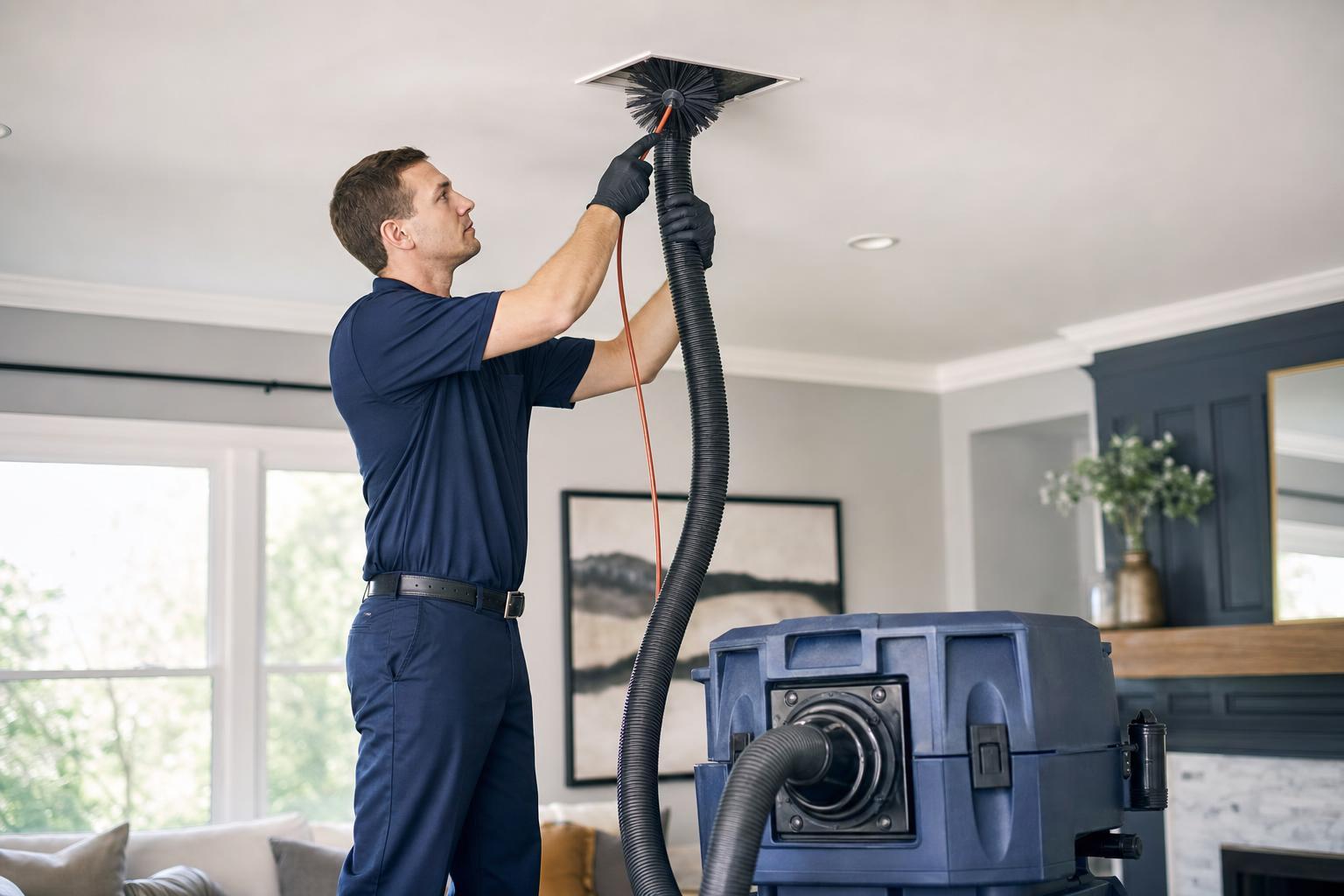
Every duct cleaning job starts with the same discipline: understand the system before you touch it with a brush. A forced-air HVAC system has three working sections. The supply side delivers conditioned air through a supply plenum, trunk lines, branch runs, boots, and registers. The return side pulls air back through return grilles, return ducts, and the return plenum. Between them sits the air-handling unit — the AHU — housing the blower, the evaporator coil, the drain pan, the heat exchanger or heating element, and the filter rack. Air loops through all of it continuously, which is why professional cleaning means restoring the entire loop to a verifiable clean condition, not vacuuming the few registers a customer can see.
- 2
Lesson 2: Safety on the Duct Job
A duct cleaning job stacks hazards that a quick walkthrough will not reveal: respirable dust and fiberglass, mold spores and rodent droppings inside the very runs you are about to agitate, possible asbestos in older systems, energized equipment at the air handler, and cramped, hot attics and crawlspaces reached by ladder. The professional habit is a deliberate hazard assessment before any tool comes off the truck — walk the system end to end, note the building's age, and decide what protections this specific job demands.
- 3
Lesson 3: Source Removal — Negative Pressure, Airflow, and Collection
Everything in professional duct cleaning hangs on one principle: source removal. Contaminants must be physically dislodged from system surfaces and physically captured — not sprayed with a deodorizer, fogged with a sanitizer, or sealed under a coating. Source removal is always two actions happening at once: agitation that breaks debris loose, and collection that captures it the moment it is loose. Take away either half and you are not cleaning; you are redistributing.
- 4
Lesson 4: Tools, Access Openings, and Inspection Equipment
You cannot clean what you cannot reach, and most of a duct system is hidden behind sheet metal, insulation, and framing. Access planning is therefore a core skill, decided at inspection rather than improvised mid-job. Use existing service openings first — at the air handler, at plenums, behind removable panels. Where they do not exist, plan openings at the base of supply and return trunks and at intervals along long runs, close enough together that your tools genuinely reach every surface between them.
- 5
Lesson 5: Executing the Cleaning — Sequence and Section Decisions
With access cut, suction confirmed, and tools matched, execution becomes a sequencing problem: move debris toward the collector, and never let it cross a section you have already cleaned. A widely used order accomplishes both. Establish negative pressure at the air handler, clean the return side first, then the supply trunk, then the branch runs, finishing at the registers farthest from the collector. Returns come first because they carry unfiltered air and are typically the dirtiest part of the system — clearing them early keeps their heavy debris from contaminating later stages of the job. The air-handling unit itself is cleaned as its own dedicated stage, so debris dislodged from the blower and coil never washes back into finished ductwork.
- 6
Lesson 6: The Air-Handling Unit and Antimicrobial Decisions
The air-handling unit is the heart of the system, and it decides whether your duct cleaning lasts. Every cubic foot of air the system moves passes through the blower, across the coil, and over the drain pan — so a scrubbed duct system wrapped around a fouled AHU is simply a clean delivery network for a dirty machine, re-soiling from the center outward. Component cleaning is therefore not an upsell; it is the part of the job that actually determines the outcome.
- 7
Lesson 7: Verification and Quality Assurance
A duct cleaning is not done when it looks done; it is done when it is verified — section by section, against the scope the customer signed. Verification is the stage that separates a professional operation from a hopeful one, and it has three layers: visual, measured, and operational.
- 8
Lesson 8: Completion, Reporting, and Documentation
Duct cleaning is sold on trust and paid on evidence. Two crews can clean the same system equally well; the one that documents the work builds a reputation and a recurring book, while the one that does not competes on price forever. The completion package is not paperwork after the job — it is the product the customer keeps.
Curriculum
What you’ll learn
- Inspect supply, return, and trunk lines to assess contamination level and decide whether cleaning is needed.
- Set up source-removal cleaning using agitation tools — air whips, skipper balls, and rotary brushes — matched to duct material and size.
- Establish negative pressure on the system with a HEPA-filtered collection unit so loosened debris is captured, not spread around.
- Build containment and protect occupant spaces during residential and commercial cleaning to prevent cross-contamination.
- Clean and service coils, blower assemblies, drain pans, and other HVAC components beyond the ductwork.
- Identify when antimicrobial treatment is appropriate and apply EPA-registered products according to label directions.
- Verify a successful cleaning using before-and-after inspection, gravimetric cleanliness checks, and photo documentation.
- Recognize and safely handle red flags — suspected asbestos, mold, or fiberglass liner damage — and know when to refer to a specialist.
What's included
Everything you get with enrollment
One price — the course, the exam, the certificate, and the tools to put it to work.
Self-paced lessons
Guided lessons with key points, safety callouts, real job scenarios, and practice checks — about 2–3 focused hours.
A real certification exam
A 20-question exam drawn from a larger question pool — 75% to pass, and every retry gets fresh questions.
Professional field documents
Branded checklists, customer agreements, and job logs printed with your company letterhead — unlocked when you pass.
Instant, verifiable certificate
Pass and download your Certificate of Completion the same day — with a unique ID anyone can confirm online.
2-year validity + renewal
Your credential is valid for two years, with a simple renewal path before it expires.
Free Find-a-Pro listing
Once certified, claim a free listing so homeowners in your area can hire you.
The process
How it works
Enroll & pay
Secure checkout, instant course access.
Complete the course + pass the exam
Guided lessons with real job scenarios, then a 20-question exam — 75% to pass, unlimited retries.
Download your certificate
Personalized certificate generated instantly, with a unique verification ID.
Your credential
Your certificate
- Holder name and course title
- Unique certificate ID
- Issue date and expiry date (2-year validity)
- Online verification by ID
A NISCR Certificate of Completion confirms completion of NISCR training and examination. It is a professional credential, not a government license. Where local law requires a license to perform a service, the technician is responsible for obtaining it.
Certificate
of Completion
This certifies that
Your Name
has completed
Air Duct Cleaning
- Certificate No.
- Valid
- NISCR-ADC-2026-XXXXXX
- 2 years
Enroll
Enroll today
$199
Course + certificate + a simple renewal option.
Try it risk-free for 3 days — full refund before you begin the final exam.
Better value
This course is part of the Complete Cleaning Bundle — 4 certifications for $640 $796 (save $156).
View the bundle →Keep going
Related certifications
Questions
Frequently asked questions
- Is this a license?
- No. This is a professional certification, not a government-issued license. It documents that you've been trained on a standards-based duct cleaning process, and it gives homeowners, facility managers, and commercial clients proof of training they can check at niscr.com/verify.
- How fast do I get the certificate?
- Same day. Once you complete the course and pass the exam — 20 questions drawn from a larger question pool, with a 75% pass mark and unlimited retries, each retry drawing a fresh set of questions — your certificate is issued immediately so you can start showing it to clients right away.
- Does my state require a license for this work?
- It varies. Some states or municipalities require a contractor's license, HVAC license, or business registration for this work, while others do not. Check your local requirements — this certification complements those requirements but does not replace any license your jurisdiction mandates.
- What's the difference between source removal and 'blow-and-go' cleaning?
- Source removal physically agitates debris loose from duct surfaces while the system is under negative pressure, so contaminants are captured in a HEPA-filtered collection unit. 'Blow-and-go' operators often just vacuum a few grilles — this course teaches the complete, verifiable method.
- Do I need my own equipment to get certified?
- No. The certification covers the process, tools, and standards so you understand how to use negative-pressure collection units, agitation devices, and HEPA equipment correctly — whether you own gear, rent it, or work for a company that supplies it.
- Can I clean commercial systems with this certification?
- Yes. The course covers both residential and larger commercial HVAC systems, including containment, component cleaning, and the documentation that property and facility managers expect for offices, schools, and multi-unit buildings.