Track B · DVC
Dryer Vent Cleaning Certification
The NISCR Dryer Vent Cleaning Certification is a $199 online, self-paced course — 8 lessons (≈2.5 hours) with a 20-question exam; pass and download a verifiable certificate the same day, valid 2 years.
Learn the standards-based process for inspecting, cleaning, and airflow-testing residential and multi-unit dryer exhaust systems to reduce fire risk — and prove your competency with a verifiable certificate homeowners and property managers can check for themselves.
- Self-paced
- Instant certificate
- 2-year validity
- Format
- Online, self-paced
- Lessons
- 8 lessons
- Time
- ≈2.5 hours
- Exam
- 20 questions
- Pass mark
- 75% · retries
- Documents
- 3 included
- Certificate
- Same day
- Validity
- 2 years
Earning potential
How much can you earn?
Per-job ticket
$100–200 / job
Daily route potential
5–8 jobs, low overhead
Recurring revenue
annual repeat customers
Illustrative ranges — actual earnings vary by location, effort, and experience, and are not guaranteed.
Why it pays
Why get certified?
Reduce fire liability
Clogged dryer vents cause thousands of home fires a year, and a documented, standards-based cleaning shows you mitigated a known hazard.
Win property-manager contracts
Show multi-unit owners and HOAs that you can service entire buildings and produce airflow records for their files.
Stand out in a crowded market
A verifiable certificate separates you from handymen with a brush, justifying premium pricing and earning customer trust on the first call.
Charge for verified results
Before-and-after airflow readings let you prove the value of your work and upsell inspections, booster-fan checks, and annual maintenance plans.
Curriculum
Inside the Dryer Vent Cleaning course
8 self-paced lessons, then a 20-question exam — 75% to pass, unlimited retries. Exam questions are drawn from a larger question pool, so every retry gets a fresh set.
- 1
Lesson 1: How a Dryer Exhaust System Works — and How It Fails
A clothes dryer is a simple machine with one non-negotiable requirement: moving air. It pulls room air in, passes it across a heat source, blows it through the tumbling load, and pushes the hot, moisture-laden exhaust out of the building through a duct. Every drop of water that leaves the clothes leaves as vapor riding that airstream. Restrict the airstream and everything degrades at once: drying times stretch, moisture lingers in the drum, the cabinet runs hotter, energy use climbs, and the machine's overheat protections begin tripping. A dryer vent technician's real product is therefore not a shiny pipe — it is restored airflow, measured with instruments and documented, because airflow is what dries clothes and airflow is what keeps lint away from ignition temperatures.
- 2
Lesson 2: Safety on the Dryer Vent Job
Dryer vent work looks tame next to demolition trades, but it stacks real hazards: appliance electricity, fuel gas, combustion exhaust, fine airborne dust, biological contamination, and ladders or rooftops at the termination end. A professional runs the same discipline on every job — identify the hazards before touching the machine, control them deliberately, and never let a routine call talk you out of the routine.
- 3
Lesson 3: Airflow and Static Pressure — the Science of the Duct
Professional dryer vent work runs on two measurements: how much air the system moves, and how hard the dryer's blower must work to move it. The first is airflow — velocity or volume at the termination. The second is static pressure — the back pressure the exhaust system imposes on the machine. Together they turn 'it looks clean' into 'it performs,' and they are what separate a verifiable service from a guess.
- 4
Lesson 4: Tools and the Pre-Cleaning Inspection
Professionals carry a kit that can inspect, measure, clean, and repair in one visit. The core: a variable-speed drill and a rotary brush kit with interlocking flexible rods rated for a specific rotation direction; a HEPA-filtered vacuum with hose extensions; hand brushes and a long lint-screen-housing brush; an inspection camera; an anemometer and a manometer; drop cloths, painter's tape, and appliance sliders; and PPE. The repair side of the box earns its space too: foil tape, spare worm-gear clamps, a length of semi-rigid metal transition duct, a replacement termination hood, and a 4-inch coupling turn 'I'll have to come back' into a finished job. Compressed-air whip systems — a compressor driving a whipping line or reverse-jet ball through the duct — are a strong addition for long or complex runs, but the rotary kit and HEPA vacuum are the foundation.
- 5
Lesson 5: Cleaning Execution — Method, Direction, and Judgment Calls
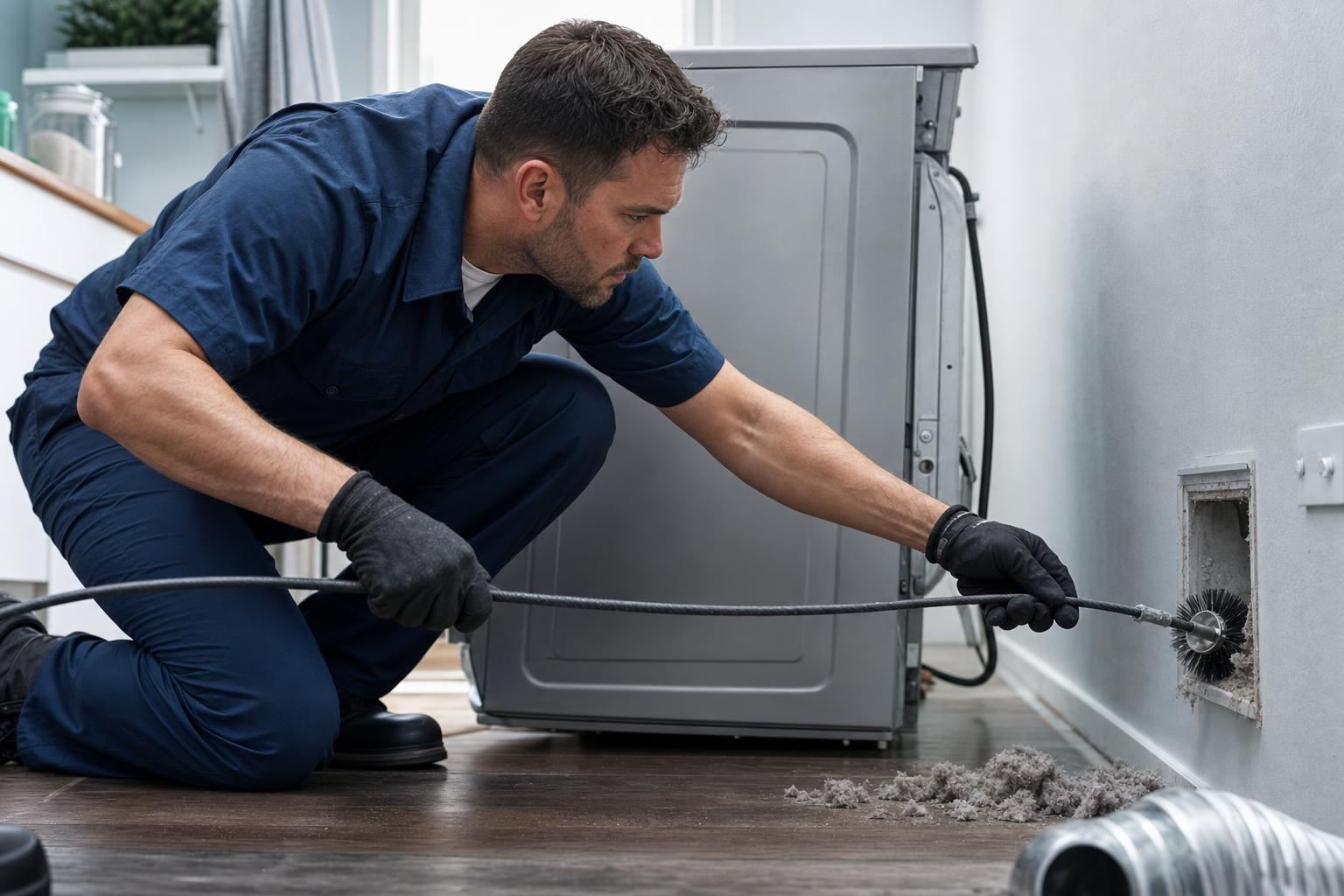
With the inspection done and the scope approved, cleaning is a controlled operation, not an attack. Plan the direction first. Where both ends are accessible, the strongest method works the duct from each end toward the middle, with the HEPA vacuum capturing at the end opposite your brush so dislodged lint moves toward capture instead of drifting through the house or packing deeper into the run. Where only one end is practical, brush toward the termination — pushing debris along the airflow direction and out of the building — with the vacuum sealed to whichever opening you can reach.
- 6
Lesson 6: Exhaust System Design and Correction
Many chronic dryer problems are not dirt but design. A system that exceeds its length budget, runs through freezing spaces, or terminates behind a pest screen will choke again months after a flawless cleaning — so a certified technician learns the rules of a correct exhaust system, fixes what is in scope on the spot, and writes up the rest. Correction is what keeps the after reading within spec and keeps the customer off next year's emergency list.
- 7
Lesson 7: Verification Testing and Troubleshooting
Verification is what your customer is actually buying. The cleaning removed lint; the after readings prove the system performs — and the discipline that makes them credible is sameness. Same instrument, same probe location just downstream of the dryer outlet, same air-only setting, same anemometer position at the hood, before and after. Change any of those mid-job and the comparison collapses into two unrelated numbers. Record both sets with the conditions noted, because a reading nobody can reproduce is an opinion.
- 8
Lesson 8: Completion, Customer Education, and Documentation
A dryer vent job is finished when the system performs and the file proves it. Two technicians can clean the same duct equally well; the one who hands over numbers, photos, and a clear report gets the renewal, the referral, and the property-manager contract — the one who hands over a bag of lint gets a shrug. Documentation is not paperwork after the work; it is the deliverable.
Curriculum
What you’ll learn
- Perform a full pre-cleaning inspection of the dryer, transition duct, and vent run to locate lint buildup, kinks, crushed sections, and improper materials.
- Identify and correct code-violating ductwork such as foil-foil flex, plastic transition hoses, and runs that exceed manufacturer length limits.
- Select and operate the right tools — rotary brush-and-rod systems, compressed-air whips, and HEPA vacuums — for the duct length, material, and routing.
- Measure airflow and static pressure before and after cleaning to verify the system meets performance targets and document the improvement.
- Safely access and service rooftop, sidewall, and shared multi-unit vent terminations, including replacing damaged or screen-clogged exterior hoods.
- Recognize the warning signs of a fire hazard — scorching, excessive drying times, overheating shutoffs — and advise the customer on corrective action.
- Reconnect the dryer correctly, confirm exhaust at the termination, and test for lint leaks at every joint before completing the job.
- Produce a clean service report with airflow readings and photos that satisfies homeowners, property managers, and insurance documentation needs.
What's included
Everything you get with enrollment
One price — the course, the exam, the certificate, and the tools to put it to work.
Self-paced lessons
Guided lessons with key points, safety callouts, real job scenarios, and practice checks — about 2–3 focused hours.
A real certification exam
A 20-question exam drawn from a larger question pool — 75% to pass, and every retry gets fresh questions.
Professional field documents
Branded checklists, customer agreements, and job logs printed with your company letterhead — unlocked when you pass.
Instant, verifiable certificate
Pass and download your Certificate of Completion the same day — with a unique ID anyone can confirm online.
2-year validity + renewal
Your credential is valid for two years, with a simple renewal path before it expires.
Free Find-a-Pro listing
Once certified, claim a free listing so homeowners in your area can hire you.
The process
How it works
Enroll & pay
Secure checkout, instant course access.
Complete the course + pass the exam
Guided lessons with real job scenarios, then a 20-question exam — 75% to pass, unlimited retries.
Download your certificate
Personalized certificate generated instantly, with a unique verification ID.
Your credential
Your certificate
- Holder name and course title
- Unique certificate ID
- Issue date and expiry date (2-year validity)
- Online verification by ID
A NISCR Certificate of Completion confirms completion of NISCR training and examination. It is a professional credential, not a government license. Where local law requires a license to perform a service, the technician is responsible for obtaining it.
Certificate
of Completion
This certifies that
Your Name
has completed
Dryer Vent Cleaning
- Certificate No.
- Valid
- NISCR-DVC-2026-XXXXXX
- 2 years
Enroll
Enroll today
$199
Course + certificate + a simple renewal option.
Try it risk-free for 3 days — full refund before you begin the final exam.
Better value
This course is part of the Complete Cleaning Bundle — 4 certifications for $640 $796 (save $156).
View the bundle →Keep going
Related certifications
Questions
Frequently asked questions
- Is this a license?
- No. NISCR certification is a professional credential that verifies you completed standards-based training in dryer vent cleaning and airflow testing. It is not a government-issued license. What it gives you is proof of training that customers and property managers can check at niscr.com/verify.
- How fast do I get the certificate?
- Same day. Once you complete the course material and pass the exam — 20 questions drawn from a larger question pool, with a 75% pass mark and unlimited retries, each retry drawing a fresh set of questions — your certificate is issued immediately so you can start booking work right away.
- Does my state require a license for this work?
- It varies by state and locality. Some areas require a general contractor or business license to operate, while many treat dryer vent cleaning as unregulated maintenance. Always check your local rules — this certification complements any required license, it does not replace one.
- Do I need expensive equipment to get started?
- No. Entry costs are low. A rotary brush-and-rod kit, a HEPA shop vacuum, and a basic anemometer for airflow readings are enough to start most residential jobs, and you can scale up to compressed-air whips and longer rod sets as you grow.
- Why is airflow testing part of the certification?
- Because a clean-looking vent can still be dangerously restricted. Measuring airflow and static pressure before and after the job is how you verify the system actually performs, prove your value to the customer, and document fire-risk reduction.
- Is there ongoing demand for dryer vent cleaning?
- Yes. Lint rebuilds with every load, so vents need servicing roughly once a year, which drives strong repeat business. Multi-unit buildings, rentals, and HOAs add steady, schedulable work on top of one-off residential calls.