Track B · CPC
Carpet Cleaning Certification
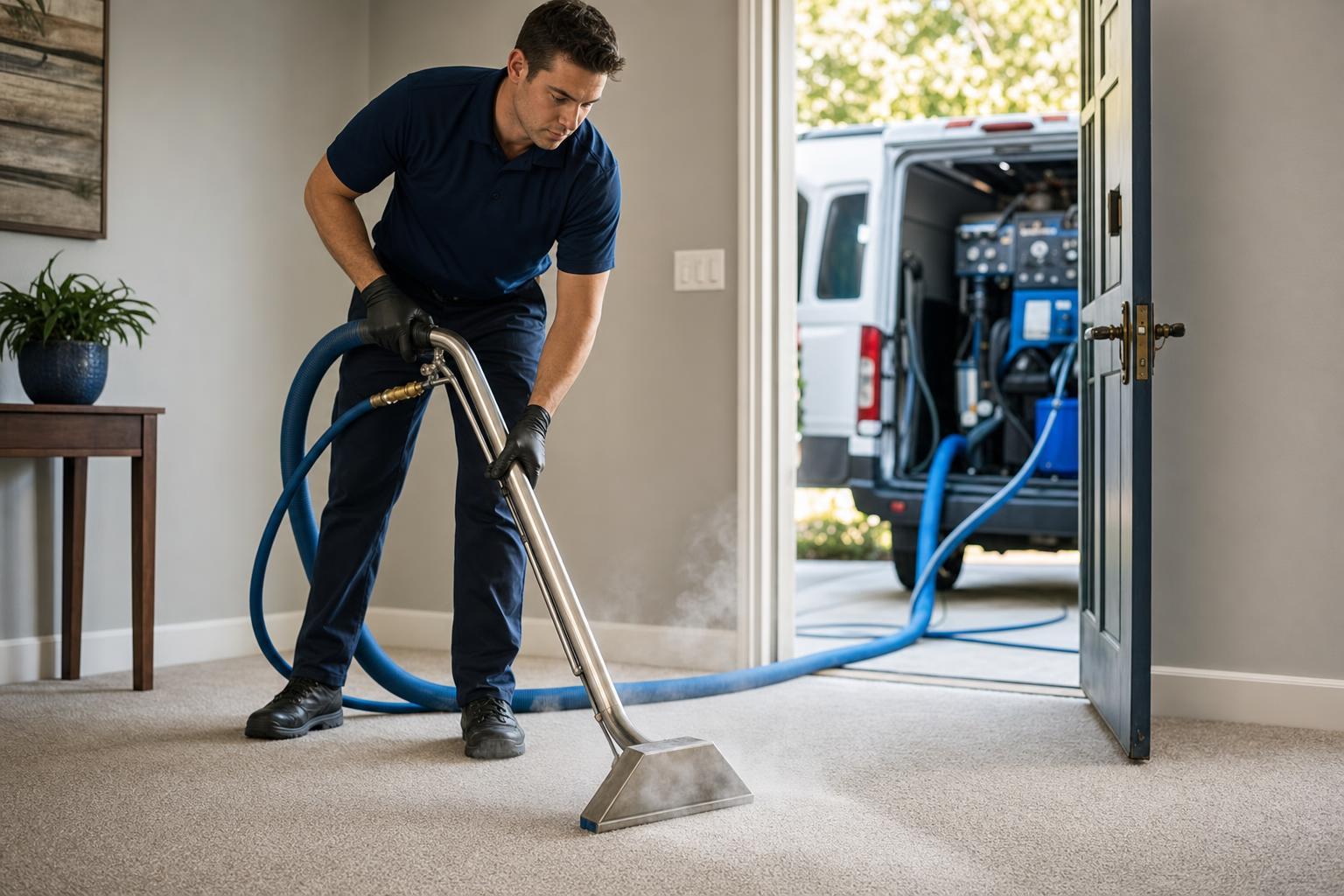
The NISCR Carpet Cleaning Certification is a $199 online, self-paced course — 8 lessons (≈2.5 hours) with a 20-question exam; pass and download a verifiable certificate the same day, valid 2 years.
Master the standards-based process for cleaning carpet the right way — identifying fibers, applying the correct hot-water extraction method, treating spots and stains, and drying to prevent damage — and prove your skill with a verifiable certificate you can show homeowners and facility managers.
- Self-paced
- Instant certificate
- 2-year validity
- Format
- Online, self-paced
- Lessons
- 8 lessons
- Time
- ≈2.5 hours
- Exam
- 20 questions
- Pass mark
- 75% · retries
- Documents
- 3 included
- Certificate
- Same day
- Validity
- 2 years
Earning potential
How much can you earn?
Per-job ticket
$100–400 / job
Recurring residential accounts
repeat seasonal & annual cleanings
Commercial contracts
scheduled route & facility work
Illustrative ranges — actual earnings vary by location, effort, and experience, and are not guaranteed.
Why it pays
Why get certified?
Win commercial contracts
Show property managers and facility buyers a documented, standards-based cleaning process and a certificate they can verify, not just a price.
Protect every fiber you touch
Knowing how to identify wool, nylon, polyester, and olefin lets you choose safe chemistry and avoid costly bleaching, browning, or texture damage.
Charge more for proven skill
A credential signals professionalism that justifies premium pricing over uncertified, bucket-and-brush competitors.
Build repeat business
Carpet that dries fast and stays clean turns one-time jobs into recurring residential and commercial customers.
Curriculum
Inside the Carpet Cleaning course
8 self-paced lessons, then a 20-question exam — 75% to pass, unlimited retries. Exam questions are drawn from a larger question pool, so every retry gets a fresh set.
- 1
Lesson 1: Fiber Identification and the Pre-Inspection Walkthrough
Every carpet cleaning job starts with a material question, because the fiber under your wand decides the chemistry, the temperature, and the outcome you can honestly promise. Carpet face fibers divide into two families. Synthetics — nylon, polyester, olefin, and triexta — dominate modern installations and tolerate reasonably aggressive cleaning within limits. Natural fibers — wool above all, plus cotton and plant fibers like sisal and jute — are far less forgiving: the wrong pH, the wrong temperature, or too much water can dull, brown, bleed, or shrink them permanently. Guess wrong and you are not cleaning; you are causing damage the customer will remember longer than any clean traffic lane.
- 2
Lesson 2: Safety and Chemical Handling on the Cleaning Job
A carpet cleaning job looks gentle from the doorway, but it stacks real hazards: concentrated chemistry, 120-volt equipment surrounded by water, solution lines hot enough to scald, hoses and cords crossing every walkway, and heavy gear moving up and down stairs. The professional habit is the same one every skilled trade uses — identify the hazards before work starts, control them deliberately, and re-check as conditions change.
- 3
Lesson 3: Soil Theory and Cleaning Chemistry
Understand what carpet soil actually is and the whole cleaning process makes sense. The large majority of it — commonly estimated at around 80 percent — is dry, particulate material: sand, grit, skin flakes, fibers, and tracked-in soil. That grit does not just look dull; it is abrasive, and every footstep grinds it against the fiber like sandpaper, scratching the surface so light stops reflecting evenly. This is why the single most important step in any carpet cleaning is thorough dry vacuuming before moisture is introduced: several slow, overlapping passes remove more soil than any later step, and dry soil that gets wet becomes mud you must now extract.
- 4
Lesson 4: Equipment, Pre-Testing, and Machine Diagnostics
Great cleaning is chemistry and technique delivered through machines, and machines only deliver when you know their jobs and their failure modes. Walk your own truck the way you walk a job site: every tool has a purpose, a set of limits, and a maintenance habit that keeps it honest.
- 5
Lesson 5: Hot-Water Extraction and Method Selection
Hot-water extraction — HWE, often marketed as steam cleaning although it works with hot water rather than steam — is the restorative standard of the trade: the method that removes the most soil from deep in the pile, and the one many carpet mills expect periodically to keep wear warranties intact. The machine injects heated solution under pressure and recovers it almost instantly, carrying suspended soil out of the carpet and into the waste tank.
- 6
Lesson 6: The Spot and Stain System
Spot work is where customers judge you in real time, and it rewards system over heroics. Start with the vocabulary that sets expectations: a spot is material sitting on or in the fiber that proper cleaning can remove; a stain has chemically bonded to the fiber or altered its dye, and may be permanent. Time converts one into the other — fresh spills release easily, aged ones set — so speed matters, and honesty about the difference matters more.
- 7
Lesson 7: Drying, Wicking, and Quality Control
Cleaning is not finished when the wand stops; it is finished when the carpet is dry and still looks clean. The working target for hot-water extraction is dry to the touch within about 6 to 12 hours, and anything creeping past 24 hours is a problem: extended wetness invites odor, browning, delamination of the backing, and microbial growth in places you cannot see. Everything in this lesson exists to make dry-down fast and to catch problems while they are still small and cheap.
- 8
Lesson 8: Completion, Documentation, and Customer Care
Professionals finish jobs twice: once on the carpet and once on paper. The last half hour — walkthrough, documentation, and care instructions — is where a good cleaning becomes a defensible record, a repeat customer, and the next referral. Skip it and even excellent technical work leaves you exposed to disputes and forgotten by spring.
Curriculum
What you’ll learn
- Identify carpet fibers — wool, nylon, polyester, olefin — and match each to safe cleaning agents and pH.
- Set up and operate hot-water extraction equipment at the correct heat, pressure, and flow for the fiber and soil level.
- Pre-vacuum, pre-condition, and agitate carpet so extraction lifts the maximum amount of embedded soil.
- Diagnose and treat common spots and stains — protein, tannin, oil-based, and dye stains — with the right spotting chemistry and sequence.
- Control dwell time and rinse thoroughly to avoid leaving sticky detergent residue that re-soils carpet.
- Apply grooming and accelerated drying techniques to return carpet to use quickly and prevent wicking, browning, and mold.
- Measure moisture and confirm proper dry-down to protect both the carpet and the subfloor.
- Document your process and results to reassure residential clients and qualify for commercial accounts.
What's included
Everything you get with enrollment
One price — the course, the exam, the certificate, and the tools to put it to work.
Self-paced lessons
Guided lessons with key points, safety callouts, real job scenarios, and practice checks — about 2–3 focused hours.
A real certification exam
A 20-question exam drawn from a larger question pool — 75% to pass, and every retry gets fresh questions.
Professional field documents
Branded checklists, customer agreements, and job logs printed with your company letterhead — unlocked when you pass.
Instant, verifiable certificate
Pass and download your Certificate of Completion the same day — with a unique ID anyone can confirm online.
2-year validity + renewal
Your credential is valid for two years, with a simple renewal path before it expires.
Free Find-a-Pro listing
Once certified, claim a free listing so homeowners in your area can hire you.
The process
How it works
Enroll & pay
Secure checkout, instant course access.
Complete the course + pass the exam
Guided lessons with real job scenarios, then a 20-question exam — 75% to pass, unlimited retries.
Download your certificate
Personalized certificate generated instantly, with a unique verification ID.
Your credential
Your certificate
- Holder name and course title
- Unique certificate ID
- Issue date and expiry date (2-year validity)
- Online verification by ID
A NISCR Certificate of Completion confirms completion of NISCR training and examination. It is a professional credential, not a government license. Where local law requires a license to perform a service, the technician is responsible for obtaining it.
Certificate
of Completion
This certifies that
Your Name
has completed
Carpet Cleaning
- Certificate No.
- Valid
- NISCR-CPC-2026-XXXXXX
- 2 years
Enroll
Enroll today
$199
Course + certificate + a simple renewal option.
Try it risk-free for 3 days — full refund before you begin the final exam.
Better value
This course is part of the Complete Cleaning Bundle — 4 certifications for $640 $796 (save $156).
View the bundle →Keep going
Related certifications
Questions
Frequently asked questions
- Is this a license?
- No. NISCR certification is a professional credential, not a government license. It verifies that you have learned and can apply a standards-based carpet cleaning process — proof of training customers and commercial accounts can check at niscr.com/verify when choosing a technician.
- How fast do I get the certificate?
- The same day. After you complete the coursework and pass the exam — 20 questions drawn from a larger question pool, with a 75% pass mark and unlimited retries, each retry drawing a fresh set of questions — your certificate is issued immediately so you can start using it on quotes, your website, and your truck right away.
- Does my state require a license for this work?
- It varies. Most areas do not require a specific license to clean carpet, but local business licensing, sales-tax registration, or contractor rules may apply. Check your city and state requirements — this certification complements those obligations, it does not replace them.
- Do I need my own truck-mount or can I use a portable extractor?
- Either works. The methods you learn — heat, pressure, flow, dwell time, and proper rinsing — apply to both truck-mounted and portable hot-water extraction units, so you can start with the equipment you already have and scale up later.
- Will this teach me how to handle delicate fibers like wool?
- Yes. Fiber identification is central to the course. You will learn how to recognize wool and other sensitive fibers and adjust chemistry, pH, heat, and agitation so you clean effectively without bleaching, browning, or distorting the pile.
- I'm new to carpet cleaning — is this course for me?
- Absolutely. The course starts with fundamentals — fiber types, soil and stain chemistry, and equipment setup — and builds to a complete extraction-to-drying workflow, so beginners gain job-ready skills while experienced cleaners can formalize and certify what they already do.