Track B · CST
Chimney Sweep Certification
The NISCR Chimney Sweep Certification is a $199 online, self-paced course — 8 lessons (≈2.5 hours) with a 20-question exam; pass and download a verifiable certificate the same day, valid 2 years.
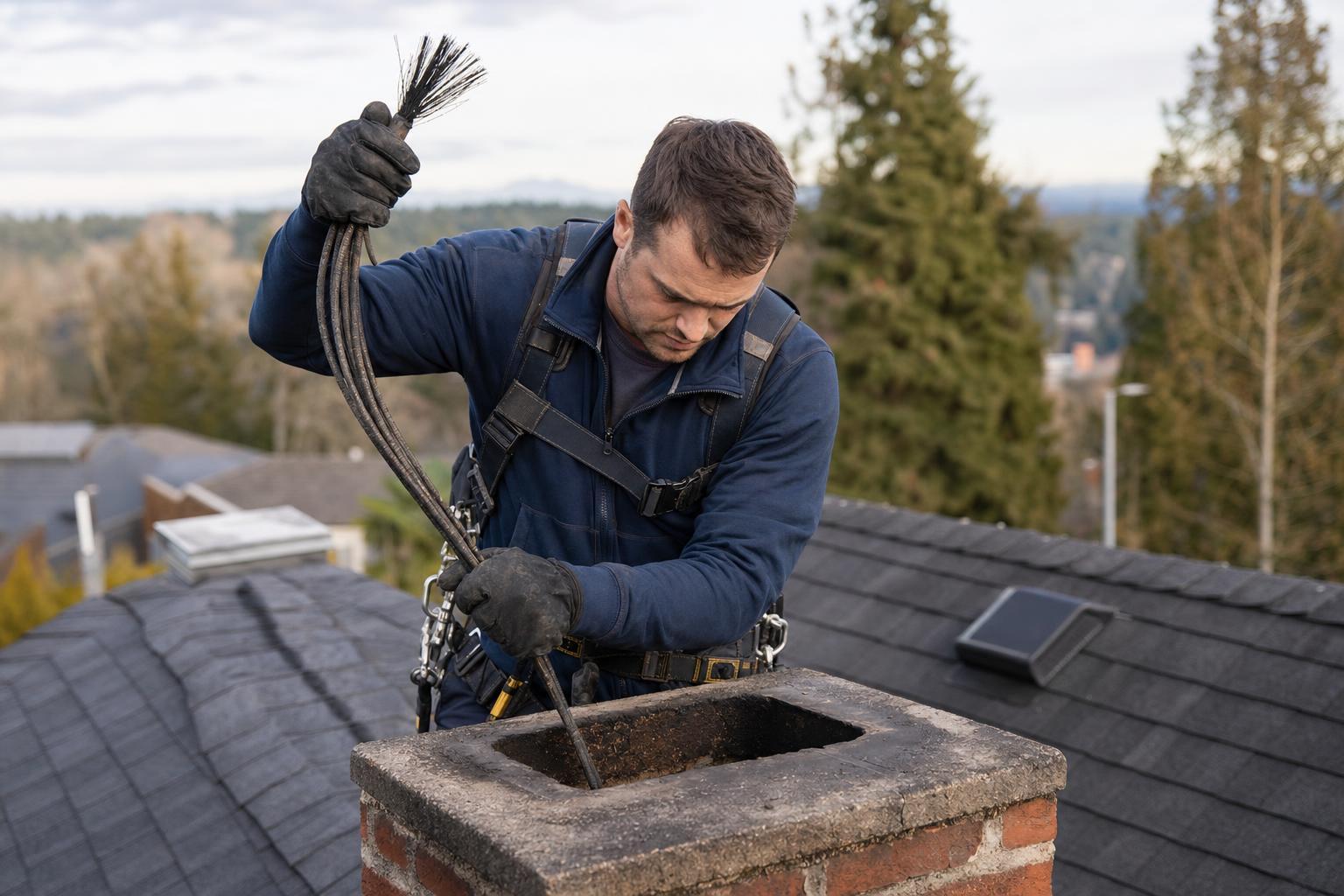
Learn the standards-based process for inspecting, sweeping, and clearing wood and gas appliances — creosote removal, level-1 inspections, and cap and damper checks — and prove your competence with a verifiable certificate homeowners can check for themselves.
- Self-paced
- Instant certificate
- 2-year validity
- Format
- Online, self-paced
- Lessons
- 8 lessons
- Time
- ≈2.5 hours
- Exam
- 20 questions
- Pass mark
- 75% · retries
- Documents
- 3 included
- Certificate
- Same day
- Validity
- 2 years
Earning potential
How much can you earn?
Standard sweep & cleaning ticket
$150–400 / job
Seasonal demand
fall & winter peaks
Add-on inspection revenue
per-chimney inspection fees on top of the sweep
Illustrative ranges — actual earnings vary by location, effort, and experience, and are not guaranteed.
Why it pays
Why get certified?
Earn homeowner trust
Customers let a stranger onto their roof and into their firebox; a certificate they can verify online helps turn a cold call into a booked job.
Document a defensible inspection
A standards-based level-1 inspection report protects you from liability and gives the homeowner a clear written record to share with their insurer or real-estate agent.
Capture the inspection upsell
Pairing every sweep with a documented inspection of the cap, damper, and flue adds a second billable service to a single visit.
Work both wood and gas safely
Training on creosote stages and combustion-byproduct hazards lets you confidently service the full range of appliances on your route.
Stand out at the bid
When a homeowner compares quotes, a certificate signals you follow a process — not just a wire brush and a shop vac.
Curriculum
Inside the Chimney Sweep course
8 self-paced lessons, then a 20-question exam — 75% to pass, unlimited retries. Exam questions are drawn from a larger question pool, so every retry gets a fresh set.
- 1
Lesson 1: Sizing Up the System — Appliance, Fuel, and Creosote Degree
Every chimney job begins before you open a tool bag, with two judgments that shape everything after them: what system you are working on, and what it has been burning. The appliance and fuel determine which hazards to expect, which tools are appropriate, and what the flue's deposits will look like. The burning history determines how heavy those deposits are likely to be, and whether the visit is a routine sweep or the discovery of a damaged system. Guess at either and you bring the wrong brush, quote the wrong job, and miss the finding that mattered.
- 2
Lesson 2: Working Safely — Roofs, Dust, Heat, and Carbon Monoxide
Chimney work concentrates four unrelated ways to get hurt: falling, breathing, burning, and the invisible chemistry of combustion. None of them is exotic, and all of them are controlled by habits you repeat identically on every job — which is why experienced sweeps get hurt less. Not because they take fewer risks, but because their setup never depends on the day's mood.
- 3
Lesson 3: Draft and Combustion — The Science of a Working Chimney
A chimney is a machine with no moving parts, powered entirely by the fact that hot gas is lighter than cold air. The column of warm combustion gas inside the flue weighs less than an equal column of outdoor air, so the atmosphere pushes the heavier air in at the bottom and the light column floats upward. That pressure difference is draft, and two variables set its strength: the temperature difference between flue gas and outside air, and the height of the warm column. Hotter fire, taller chimney, stronger draft. Nearly everything you will ever diagnose about a smoking fireplace traces back to this equation.
- 4
Lesson 4: Inspection Levels and the Systematic Inspection
Industry-standard practice divides chimney inspections into three levels, and choosing the right one matters as much as any defect you will ever find. The level defines the scope, the scope defines what your report can honestly say, and the gap between what you actually saw and what you signed is where liability lives.
- 5
Lesson 5: Sweeping Execution — Brushes, Rods, Rotary, and Containment
Sweeping is a matching exercise before it is an effort exercise: the brush to the flue, the rod to the route, and the method to the deposit. Get the matches right and the flue gives up its deposits in orderly passes; get them wrong and you can labor for an hour, score a liner, and still leave the hazard on the wall.
- 6
Lesson 6: Components and Clearances — Caps, Crowns, Dampers, and Liners
A chimney is a stack of components that each do one narrow job — shed water, pass smoke, exclude animals, contain heat — and reading them well is what turns a cleaning visit into the inspection that actually protects the household. Component evaluation is also where recommendations earn their keep: most of what goes wrong at the top of a chimney is cheap to fix early and expensive to ignore.
- 7
Lesson 7: Verification and Quality Assurance — Proving the System Works
Brushing a flue and proving a flue is clean are two different accomplishments, and only the second one belongs on your report. Verification is the quality-assurance phase of the visit: a deliberate set of checks, run the same way every time, that turns 'I swept it' into 'it is clean, intact, and drawing' — a claim you have evidence for.
- 8
Lesson 8: Reporting, Recommendations, and Professional Boundaries
Every chimney visit is judged twice: once at the hearth, when the homeowner sees a clean firebox, and again — sometimes years later — on paper, when an insurer, a home buyer, or an attorney reads what you wrote. The sweeping is the service; the report is the product that survives. Write every report as if a stranger will read it after a fire, because occasionally one will.
Curriculum
What you’ll learn
- Identify the three stages of creosote buildup and select the correct removal method — brushing, rotary, or recommending specialist treatment — for each.
- Perform a level-1 inspection of a readily accessible flue, connector, and appliance, and document findings in a clear written report.
- Inspect chimney caps and spark arrestors for damage, blockage, and animals or debris getting in, and recommend repairs.
- Test damper operation and seating to confirm proper draft and a positive seal when the appliance is not in use.
- Recognize the distinct hazards of wood-burning versus gas appliances, including creosote ignition risk and carbon-monoxide and acidic-condensate concerns on gas flues.
- Set up and break down the job to protect the home — drop cloths, dual-HEPA vacuum containment, and soot control around the firebox.
- Use rod-and-brush, rotary, and inspection-camera tools correctly and match brush size and material to the flue type.
- Spot common defects — flue cracks, blockages, missing liners, and improper clearances — that warrant a higher-level inspection or service refusal.
What's included
Everything you get with enrollment
One price — the course, the exam, the certificate, and the tools to put it to work.
Self-paced lessons
Guided lessons with key points, safety callouts, real job scenarios, and practice checks — about 2–3 focused hours.
A real certification exam
A 20-question exam drawn from a larger question pool — 75% to pass, and every retry gets fresh questions.
Professional field documents
Branded checklists, customer agreements, and job logs printed with your company letterhead — unlocked when you pass.
Instant, verifiable certificate
Pass and download your Certificate of Completion the same day — with a unique ID anyone can confirm online.
2-year validity + renewal
Your credential is valid for two years, with a simple renewal path before it expires.
Free Find-a-Pro listing
Once certified, claim a free listing so homeowners in your area can hire you.
The process
How it works
Enroll & pay
Secure checkout, instant course access.
Complete the course + pass the exam
Guided lessons with real job scenarios, then a 20-question exam — 75% to pass, unlimited retries.
Download your certificate
Personalized certificate generated instantly, with a unique verification ID.
Your credential
Your certificate
- Holder name and course title
- Unique certificate ID
- Issue date and expiry date (2-year validity)
- Online verification by ID
A NISCR Certificate of Completion confirms completion of NISCR training and examination. It is a professional credential, not a government license. Where local law requires a license to perform a service, the technician is responsible for obtaining it.
Certificate
of Completion
This certifies that
Your Name
has completed
Chimney Sweep
- Certificate No.
- Valid
- NISCR-CST-2026-XXXXXX
- 2 years
Enroll
Enroll today
$199
Course + certificate + a simple renewal option.
Try it risk-free for 3 days — full refund before you begin the final exam.
Keep going
Related certifications
Questions
Frequently asked questions
- Is this a license?
- No. NISCR is not a government agency, and this is not a state-issued license. It is a professional certification that documents you have been trained in and tested on a standards-based chimney sweeping and inspection process.
- How fast do I get the certificate?
- The same day. Once you complete the course and pass the final exam — 20 questions drawn from a larger question pool, with a 75% pass mark and unlimited retries, each retry drawing a fresh set of questions — your certificate is issued immediately for you to download and print.
- Does my state require a license for this work?
- It varies. Some states and municipalities require a business, contractor, or solid-fuel license for chimney work, while others do not. Always check your local requirements — this certification complements those rules and does not replace any license your jurisdiction mandates.
- Does this cover both wood and gas appliances?
- Yes. The course addresses safety and inspection practices for both wood-burning and gas appliances, including the different creosote, draft, carbon-monoxide, and condensate concerns each presents.
- What level of inspection does this certify me for?
- The course focuses on the level-1 inspection — the routine visual inspection of readily accessible portions of the chimney and appliance — and teaches you to recognize when a defect calls for a more invasive level-2 or level-3 inspection by a specialist.
- Do I need prior experience to take this course?
- No prior certification is required. The course is built for newcomers entering the trade and for working sweeps who want a documented credential, walking through tools, process, and safety from the ground up.