Track D · MIA
Mold Inspection & Assessment Certification
The NISCR Mold Inspection & Assessment Certification is a $199 online, self-paced course — 8 lessons (≈2.5 hours) with a 20-question exam; pass and download a verifiable certificate the same day, valid 2 years.
Master the standards-based process for finding, sampling, and assessing mold in buildings, and prove it with a credential property owners and managers can verify in seconds.
- Self-paced
- Instant certificate
- 2-year validity
- Format
- Online, self-paced
- Lessons
- 8 lessons
- Time
- ≈2.5 hours
- Exam
- 20 questions
- Pass mark
- 75% · retries
- Documents
- 3 included
- Certificate
- Same day
- Validity
- 2 years
Earning potential
How much can you earn?
Inspector hourly
$25-45 / hr
Self-employed inspection fee
$300-1,000+
Owner potential
Varies by market
Illustrative ranges — actual earnings vary by location, effort, and experience, and are not guaranteed.
Why it pays
Why get certified?
Open a high-demand niche
Mold assessment is a specialized service that buyers, landlords, and managers actively search for. A verifiable credential helps you get found and chosen over uncertified competitors.
Charge professional fees
A documented, standards-based inspection with lab sampling and a written report earns a real fee. Clients pay for clarity and defensible findings, not a quick look around.
Build trust fast
Mold is an emotional, high-stakes topic for clients. A credential plus a step-by-step process signals you are objective and competent, which closes jobs and earns referrals.
Start or grow a business
Assessment requires modest equipment and no remediation crew. It is a practical way to launch a solo inspection business or add a profitable line to an existing inspection or restoration company.
Curriculum
Inside the Mold Inspection & Assessment course
8 self-paced lessons, then a 20-question exam — 75% to pass, unlimited retries. Exam questions are drawn from a larger question pool, so every retry gets a fresh set.
- 1
Lesson 1: The Inspector's Role — Assessment, Not Remediation
Every mold inspection exists to answer three questions, and keeping them in order keeps you honest. Is there a mold problem? What is causing it? And what conditions are feeding it? Your job is to investigate, measure, document, and report — not to clean, remove, or repair. That line is the foundation of the trade, and blurring it is the fastest way to lose both your objectivity and your legal footing.
- 2
Lesson 2: Safety on the Mold Inspection
An inspection looks low-risk next to demolition, but mold work carries real hazards, and the biggest ones are the ones you create by disturbing what you came to study. Poking suspected growth, pulling back carpet, or opening a wall cavity can release a cloud of spores in seconds. Protecting yourself is not optional professionalism; it is how you avoid sensitizing your own body to the very exposures you will face on every future job.
- 3
Lesson 3: How Mold Grows — Moisture, Materials, and Conditions
To find mold reliably you have to understand what it needs, because you are really hunting for its requirements, not the fuzz itself. Mold needs four things at once: viable spores, a food source, a temperature it tolerates, and moisture. Take away any one and growth stops. The catch is that three of the four are almost always present in an occupied building, which is why the whole trade turns on the fourth.
- 4
Lesson 4: The Visual Inspection and Moisture Mapping
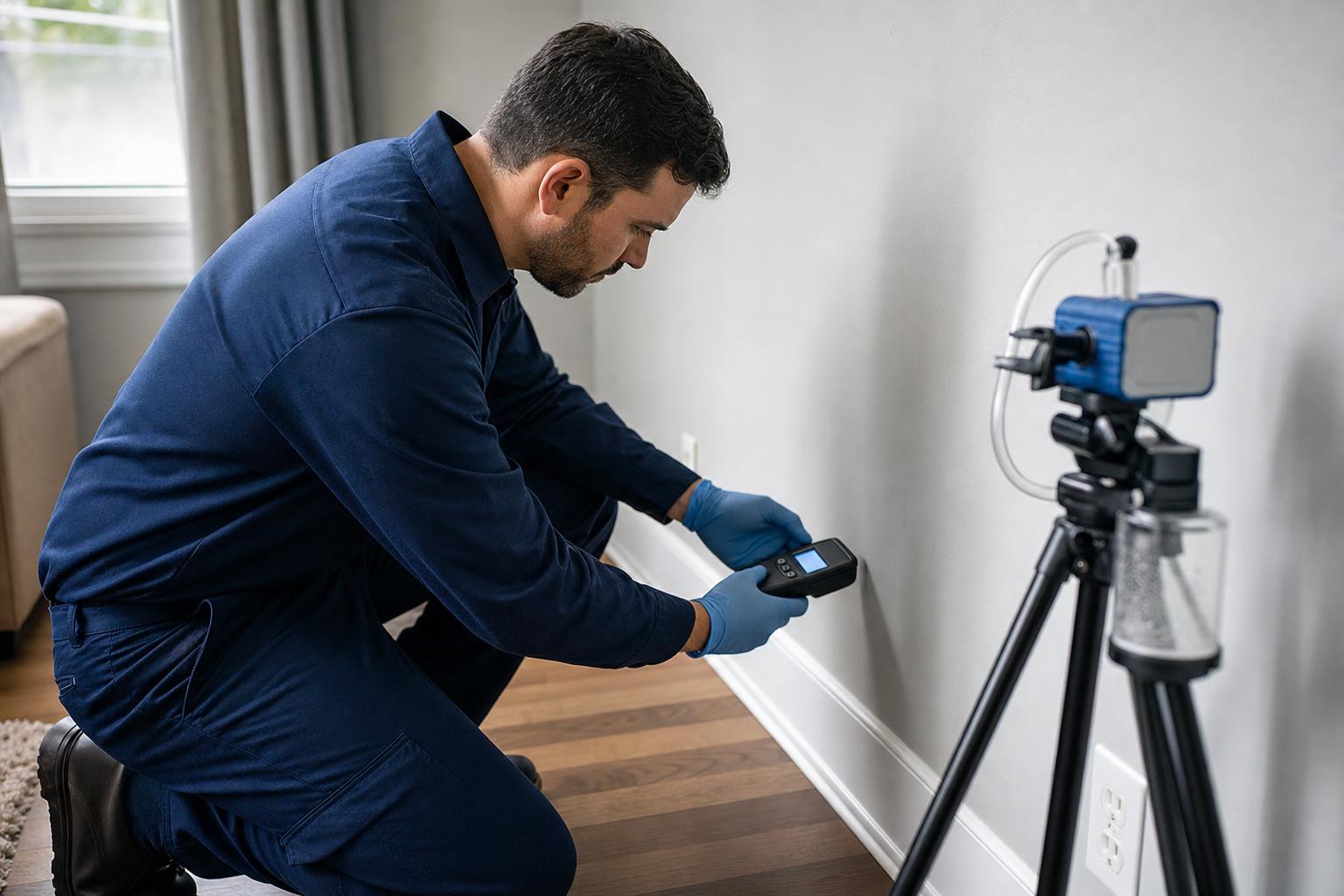
The visual inspection is the backbone of every assessment, and instruments turn what could be a guess into evidence. Work the building in a consistent room-by-room pattern so you never skip an area, and give the same attention to every space whether or not the client pointed you there. Look at ceilings, wall-to-floor junctions, around windows and doors, under sinks, behind toilets, at the base of exterior walls, and anywhere plumbing or HVAC runs. Use your senses as you go: a musty, earthy odor frequently signals hidden growth even when nothing is visible.
- 5
Lesson 5: Sampling Methods and Chain of Custody
Sampling supplements the visual inspection; it never replaces it. You sample to answer a specific question — to confirm that a suspect material is actually growing mold, to identify what genera are present, or to compare the indoor air to the outdoor air — and if you cannot state the question a sample will answer, you probably do not need it. Reflexive sampling wastes the client's money and lab turnaround and can even muddy a report by introducing numbers no one knows how to use.
- 6
Lesson 6: Interpreting Laboratory Results
Laboratory results only mean something once you interpret them, and the most common mistake is looking for a single number that declares a building safe or unsafe. In the United States there is no universal numeric pass-or-fail limit for airborne mold. You interpret results by comparison and pattern — indoor versus outdoor, the mix of genera present, and how the lab data lines up with what you saw and measured — not against a magic threshold that does not exist.
- 7
Lesson 7: Post-Remediation Verification and Clearance
The assessment does not truly end when the remediator finishes; it ends when someone independent confirms the work actually succeeded. Post-remediation verification — often called clearance — is the quality check that protects the client from paying for a cleanup that looks done but is not, and it is frequently your role precisely because you did not perform the work. Just as diagnosis should be independent of the fix, so should the final grade, and in many jurisdictions that independence is required rather than merely preferred.
- 8
Lesson 8: Writing the Assessment Report and Defining Scope
The report is your product. Everything else you do — the walk-through, the meter readings, the samples — exists to feed a document a reader who never set foot in the building can understand and act on. Write in plain, objective language, and structure it so the reader can follow your reasoning from what you found to what they should do. A brilliant inspection buried in a vague or disorganized report is a job half done.
Curriculum
What you’ll learn
- Conduct a systematic visual mold inspection of a building, room by room
- Map moisture using a moisture meter, hygrometer, and infrared camera to find hidden problems
- Identify the conditions that lead to mold growth, including water leaks and high humidity
- Collect air and surface samples using correct methods and equipment
- Maintain a defensible chain of custody from sample collection to the laboratory
- Interpret laboratory results and compare indoor to outdoor spore counts
- Recognize the line between assessment and remediation and stay within your scope
- Write a clear, objective assessment report with findings, photos, and recommendations
What's included
Everything you get with enrollment
One price — the course, the exam, the certificate, and the tools to put it to work.
Self-paced lessons
Guided lessons with key points, safety callouts, real job scenarios, and practice checks — about 2–3 focused hours.
A real certification exam
A 20-question exam drawn from a larger question pool — 75% to pass, and every retry gets fresh questions.
Professional field documents
Branded checklists, customer agreements, and job logs printed with your company letterhead — unlocked when you pass.
Instant, verifiable certificate
Pass and download your Certificate of Completion the same day — with a unique ID anyone can confirm online.
2-year validity + renewal
Your credential is valid for two years, with a simple renewal path before it expires.
Free Find-a-Pro listing
Once certified, claim a free listing so homeowners in your area can hire you.
The process
How it works
Enroll & pay
Secure checkout, instant course access.
Complete the course + pass the exam
Guided lessons with real job scenarios, then a 20-question exam — 75% to pass, unlimited retries.
Download your certificate
Personalized certificate generated instantly, with a unique verification ID.
Your credential
Your certificate
- Holder name and course title
- Unique certificate ID
- Issue date and expiry date (2-year validity)
- Online verification by ID
A NISCR Certificate of Completion confirms completion of NISCR training and examination. It is a professional credential, not a government license. Where local law requires a license to perform a service, the technician is responsible for obtaining it.
Certificate
of Completion
This certifies that
Your Name
has completed
Mold Inspection & Assessment
- Certificate No.
- Valid
- NISCR-MIA-2026-XXXXXX
- 2 years
Enroll
Enroll today
$199
Course + certificate + a simple renewal option.
Try it risk-free for 3 days — full refund before you begin the final exam.
Better value
This course is part of the Complete Inspection Bundle — 6 certifications for $1000 $1244 (save $244).
View the bundle →Keep going
Related certifications
Questions
Frequently asked questions
- Is this a license?
- No. A NISCR Certificate of Completion is a professional credential confirming you completed NISCR training and passed the examination. It is not a government license. Some states regulate or license mold assessors, and where a license is required, you are responsible for obtaining it. This certificate documents your training; it does not replace any locally required license.
- How fast do I get my certificate?
- The same day. As soon as you finish the course and pass the exam, your Certificate of Completion is issued and available to download and print immediately.
- Do I need a state license to do mold assessment?
- It varies by state. Some states require mold assessors to be licensed or registered, sometimes separately from remediators, while others have no specific requirement. Check the rules where you work before taking on paid jobs. This course prepares you with the knowledge; verifying and meeting local licensing is your responsibility.
- How long is the certificate valid?
- The certificate is valid for 2 years (24 months). After that you renew to keep your credential current and in line with the latest best practices and standards.
- Is there an exam?
- Yes. It is a 20-question exam drawn from a larger question pool, with a 75% pass mark and unlimited retries at no extra cost; each retry draws a fresh set of questions, so you can review the material and try again until you pass.
- Is the course self-paced?
- Yes. The course is fully online and self-paced. Start, stop, and resume whenever you want, and complete it on your own schedule from any device.