Track D · MTI
Moisture & Thermal Imaging Inspection Certification
The NISCR Moisture & Thermal Imaging Inspection Certification is a $199 online, self-paced course — 8 lessons (≈2.5 hours) with a 20-question exam; pass and download a verifiable certificate the same day, valid 2 years.
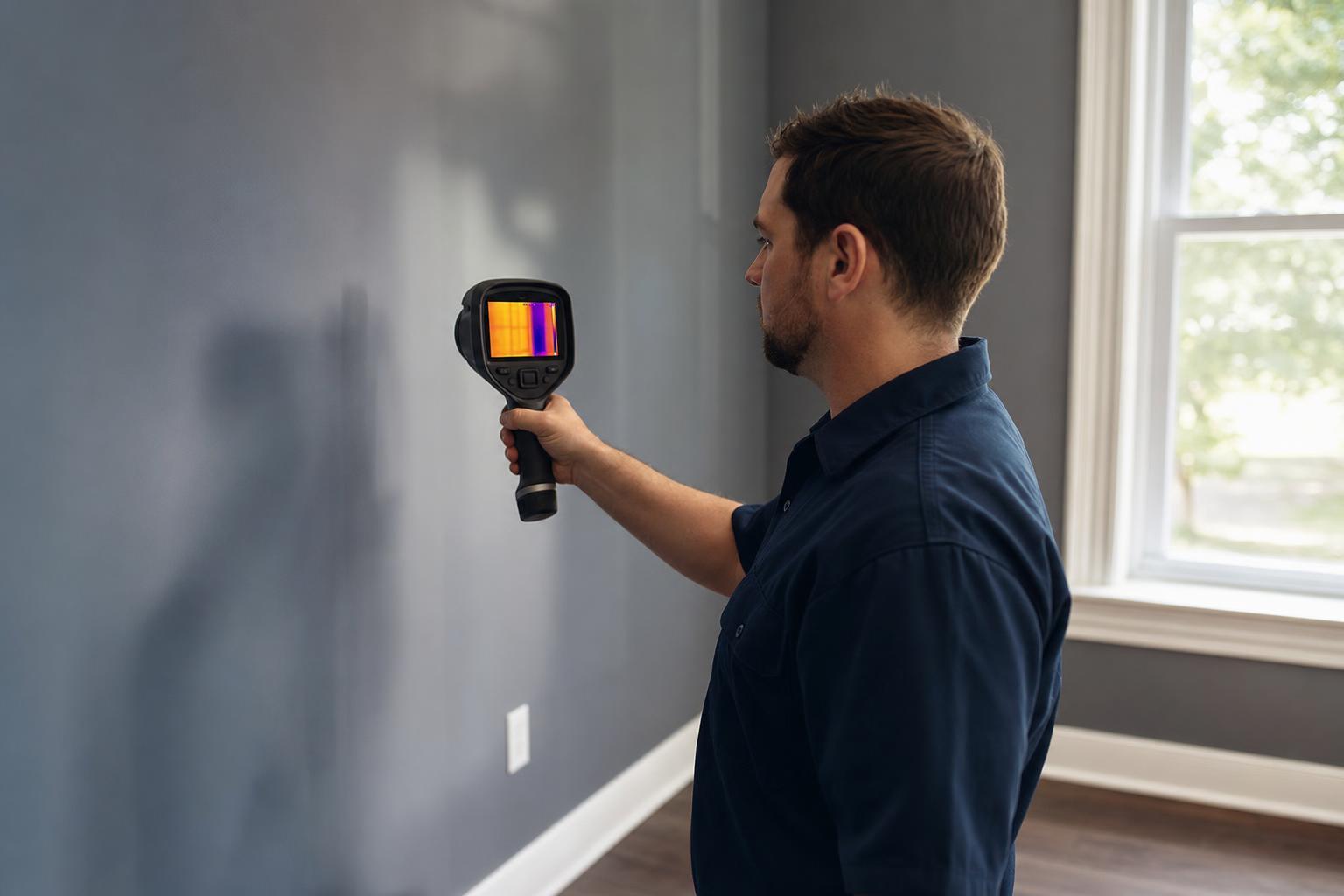
Master the systematic process for finding hidden moisture, leaks, missing insulation, and energy loss with infrared thermal cameras and moisture meters, and prove it with a credential customers and building professionals can verify in seconds.
- Self-paced
- Instant certificate
- 2-year validity
- Format
- Online, self-paced
- Lessons
- 8 lessons
- Time
- ≈2.5 hours
- Exam
- 20 questions
- Pass mark
- 75% · retries
- Documents
- 3 included
- Certificate
- Same day
- Validity
- 2 years
Earning potential
How much can you earn?
Inspector hourly
$22-40 / hr
Self-employed scan/report
$200-800+
Owner potential
Varies by market
Illustrative ranges — actual earnings vary by location, effort, and experience, and are not guaranteed.
Why it pays
Why get certified?
Find problems others miss
Infrared and moisture meters reveal leaks, wet building materials, and missing insulation behind finished surfaces, so you catch issues before they become costly mold or structural damage.
Charge more for diagnostics
A documented thermal and moisture scan is a high-value add-on. Inspectors and contractors who can image a building and back it up with meter readings command premium rates over visual-only inspections.
Build trust fast
Clear thermal images and moisture maps let customers see the problem for themselves. Visual evidence shortens arguments, speeds approvals, and makes your reports convincing to owners, insurers, and adjusters.
Start or grow a business
Add thermal imaging to home inspection, restoration, energy auditing, or HVAC work, or launch a standalone moisture diagnostics service with relatively low equipment overhead.
Curriculum
Inside the Moisture & Thermal Imaging Inspection course
8 self-paced lessons, then a 20-question exam — 75% to pass, unlimited retries. Exam questions are drawn from a larger question pool, so every retry gets a fresh set.
- 1
Lesson 1: Scoping the Inspection — Client Concern, Access, and Expectations
Every moisture and thermal inspection begins before the camera comes out of the case, with a conversation and a walk-through that define what you are actually being asked to find. A scan run without a clear scope produces a beautiful set of images that answer no one's question. The first professional habit is to pin down the concern, the access, and the conditions — because all three shape what you can honestly deliver.
- 2
Lesson 2: Working Safely on a Moisture and Thermal Inspection
A moisture and thermal inspection feels low-risk — you are mostly looking, not demolishing — and that is exactly why technicians get hurt on them. You go where the problems are: into damp basements and crawlspaces, up ladders to reach ceilings and rooflines, and close to the electrical and mechanical systems that thermal scanning is meant to examine. Safety on this trade is about the environments you enter and the systems you get near, and it starts with a deliberate hazard walk before you scan.
- 3
Lesson 3: How Thermal Imaging Actually Works
An infrared camera does not see moisture, mold, or wires. It sees surface temperature. Every object above absolute zero emits infrared energy, and the camera measures that energy from the surfaces in its view and converts it into a temperature map you read as colors or grayscale. Everything else this trade does rests on that single fact — so getting it firmly in mind is the difference between an inspector who interprets images and one who is fooled by them.
- 4
Lesson 4: Delta-T, Emissivity, and Capturing Accurate Images
A thermal camera can only reveal a difference that exists to be revealed. If the two sides of a wall are the same temperature, there is nothing for the camera to show, no matter how good it is. This is the single idea that governs whether an inspection is even worth doing on a given day — and it, along with emissivity and reflection, is what separates accurate images from confident-looking nonsense.
- 5
Lesson 5: Confirming Findings With Moisture Meters
The thermal camera finds the suspect area; the moisture meter proves whether it is actually wet. This is the central discipline of the trade, and violating it is the fastest way to lose credibility: never report moisture on infrared evidence alone. A cool anomaly has many innocent causes — a draft, a cold water line, a shaded corner, a recessed light, a patch of different material — and only a meter reading tells you which anomalies are water and which are harmless physics. The camera narrows the search; the meter closes it.
- 6
Lesson 6: Reading Building Thermal Patterns
Once you accept that the camera shows temperature, buildings become surprisingly readable, because heat moves through a structure in predictable ways. Learning the common thermal signatures — and, just as important, the normal ones that are not defects — is what lets you separate a finding from ordinary physics. This is pattern recognition built on the science from earlier lessons.
- 7
Lesson 7: Avoiding False Positives and Verifying Anomalies
Most beginner mistakes on this trade come from trusting a single striking image. The discipline that separates a credible inspector from one who frightens clients with normal physics is systematic verification: before any anomaly becomes a finding, you rule out the ordinary explanations. This lesson is the quality-control loop that every anomaly must pass through.
- 8
Lesson 8: Documentation and Professional Reporting
A finding nobody can understand or trust later is worthless. Strong documentation is what makes your work defensible, billable, and genuinely useful to the people who act on it — and on this trade, the report is the deliverable. Customers and insurers are not paying for the hour you spent scanning; they are paying for the clear, honest record of what you found. This lesson is how you finish the job so the results, and the invoice, are beyond dispute.
Curriculum
What you’ll learn
- Operate an infrared thermal camera and adjust span, level, and palette to reveal subtle temperature differences
- Identify the difference between active leaks, residual moisture, and normal thermal patterns in walls, ceilings, and floors
- Confirm every suspected moisture finding with a pin or pinless moisture meter before reporting it
- Locate missing, settled, or wet insulation and air-leakage paths in the building envelope
- Apply delta-T and emissivity basics to capture accurate, repeatable thermal images
- Recognize and avoid false positives from reflections, solar loading, and surface material differences
- Document findings with paired thermal images, control photos, meter readings, and clear location notes
- Produce a professional inspection report that customers, contractors, and insurers can act on
What's included
Everything you get with enrollment
One price — the course, the exam, the certificate, and the tools to put it to work.
Self-paced lessons
Guided lessons with key points, safety callouts, real job scenarios, and practice checks — about 2–3 focused hours.
A real certification exam
A 20-question exam drawn from a larger question pool — 75% to pass, and every retry gets fresh questions.
Professional field documents
Branded checklists, customer agreements, and job logs printed with your company letterhead — unlocked when you pass.
Instant, verifiable certificate
Pass and download your Certificate of Completion the same day — with a unique ID anyone can confirm online.
2-year validity + renewal
Your credential is valid for two years, with a simple renewal path before it expires.
Free Find-a-Pro listing
Once certified, claim a free listing so homeowners in your area can hire you.
The process
How it works
Enroll & pay
Secure checkout, instant course access.
Complete the course + pass the exam
Guided lessons with real job scenarios, then a 20-question exam — 75% to pass, unlimited retries.
Download your certificate
Personalized certificate generated instantly, with a unique verification ID.
Your credential
Your certificate
- Holder name and course title
- Unique certificate ID
- Issue date and expiry date (2-year validity)
- Online verification by ID
A NISCR Certificate of Completion confirms completion of NISCR training and examination. It is a professional credential, not a government license. Where local law requires a license to perform a service, the technician is responsible for obtaining it.
Certificate
of Completion
This certifies that
Your Name
has completed
Moisture & Thermal Imaging Inspection
- Certificate No.
- Valid
- NISCR-MTI-2026-XXXXXX
- 2 years
Enroll
Enroll today
$199
Course + certificate + a simple renewal option.
Try it risk-free for 3 days — full refund before you begin the final exam.
Better value
This course is part of the Complete Inspection Bundle — 6 certifications for $1000 $1244 (save $244).
View the bundle →Keep going
Related certifications
Questions
Frequently asked questions
- Is this a license?
- No. A NISCR Certificate of Completion is a professional credential confirming you completed NISCR training and passed the examination. It is not a government license. You are responsible for obtaining any license your state or locality requires to perform inspection work.
- How fast do I get my certificate?
- Same day. As soon as you pass the exam, your Certificate of Completion is issued and available to download and print immediately.
- Do I need a state license to do this work?
- It varies by state and locality. Some areas regulate home inspectors, energy auditors, or related trades, while others do not. Check your state and local requirements, since you are responsible for holding any license the law requires.
- How long is the certificate valid?
- The certificate is valid for 2 years (24 months). After that you can renew to keep your credential current and reflect any updated practices.
- Is there an exam?
- Yes. It is a 20-question exam drawn from a larger question pool, with a 75% pass mark and unlimited retries at no extra cost; each retry draws a fresh set of questions, so you can review the material and try again until you pass.
- Is the course self-paced?
- Yes. The course is fully self-paced and online. Start, stop, and resume whenever you want, and complete it as quickly or as gradually as fits your schedule.