Track D · IAQ
Indoor Air Quality Inspection Certification
The NISCR Indoor Air Quality Inspection Certification is a $199 online, self-paced course — 8 lessons (≈2.5 hours) with a 20-question exam; pass and download a verifiable certificate the same day, valid 2 years.
Master a systematic process for measuring indoor air quality, interpreting the readings, and recommending corrective actions, and prove it with a credential homeowners, building managers, and clients can verify in seconds.
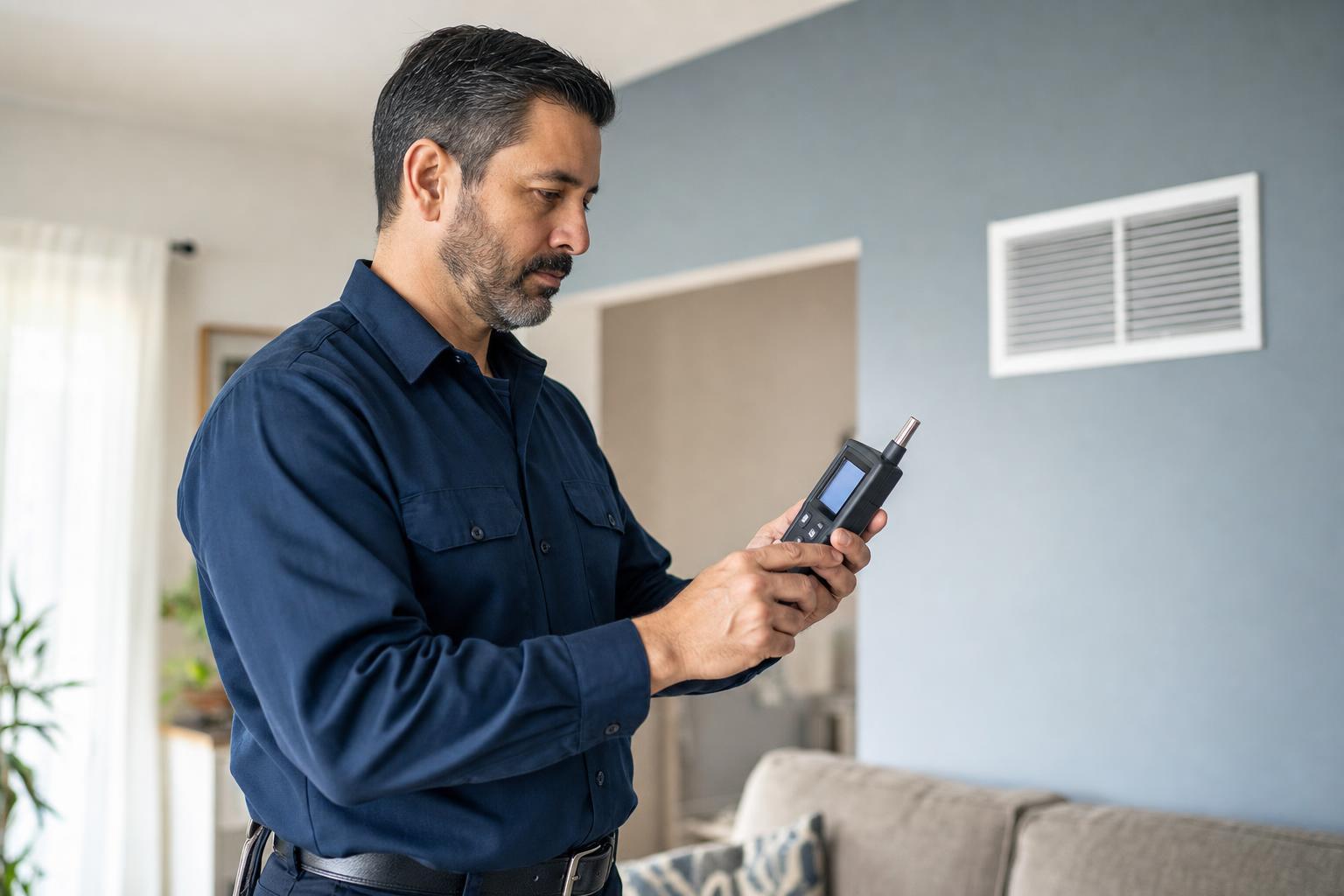
- Self-paced
- Instant certificate
- 2-year validity
- Format
- Online, self-paced
- Lessons
- 8 lessons
- Time
- ≈2.5 hours
- Exam
- 20 questions
- Pass mark
- 75% · retries
- Documents
- 3 included
- Certificate
- Same day
- Validity
- 2 years
Earning potential
How much can you earn?
Technician hourly
$22-40 / hr
Self-employed inspection ticket
$250-600+
Owner potential
Varies by market
Illustrative ranges — actual earnings vary by location, effort, and experience, and are not guaranteed.
Why it pays
Why get certified?
Win inspection work
Homeowners, landlords, and property managers hire technicians who can document a clear, repeatable assessment process and explain what the numbers mean.
Charge more
Understanding instruments, baselines, and ventilation lets you offer a complete assessment with a written report instead of competing on a cheap walk-through.
Build trust fast
A verifiable credential reassures a worried client who suspects a problem with the air their family or tenants are breathing.
Start or grow a business
IAQ concerns pair naturally with restoration, HVAC, and home-inspection services, giving you a billable add-on or a standalone offering.
Curriculum
Inside the Indoor Air Quality Inspection course
8 self-paced lessons, then a 20-question exam — 75% to pass, unlimited retries. Exam questions are drawn from a larger question pool, so every retry gets a fresh set.
- 1
Lesson 1: Sizing Up the Complaint — Pollutants, Sources, and the Intake Interview
An indoor air quality inspection starts before any instrument turns on, with two judgments that shape everything after: what family of pollutant the complaint points toward, and whether its likely source is inside the building or coming in from outside. Get those two right and your instruments confirm a hypothesis; get them wrong and you spend the visit collecting numbers that answer the wrong question. The pollutants you will encounter fall into a few predictable groups, and each group has sources you can trace during a walkthrough.
- 2
Lesson 2: Safety on the IAQ Inspection
An IAQ inspection looks gentle from the outside — no demolition, no standing water — but it routinely puts you in the two most hazardous parts of a building, attics and crawlspaces, and it puts you inside homes where the very hazard you were called about may be active. The professional habit is the same as in any inspection trade: assess the hazards before you work, protect yourself deliberately, and know which conditions mean the inspection stops.
- 3
Lesson 3: How Buildings Breathe — Ventilation, Pressure, and Moisture Science
Most chronic IAQ complaints trace back to how a building exchanges air and manages moisture, so the science of building airflow is the core knowledge of this trade. Master three ideas — dilution, pressure, and dew point — and the majority of what you measure in the field will start explaining itself.
- 4
Lesson 4: Instruments and Measurement Technique
Your credibility rides on your instruments — and even more on your technique. IAQ field work does not require a laboratory, but it does require knowing exactly what each device measures, what it cannot measure, and how to take a reading that means something. A perfect meter used carelessly produces confident nonsense.
- 5
Lesson 5: Interpreting Readings — Context, Ratios, and When to Escalate
Clients do not pay for numbers; they pay for judgment about numbers. Interpretation is where an IAQ inspector earns the fee — turning a page of readings into 'here is what is going on, here is how confident I am, and here is who you need next.' Three habits make interpretation professional: use reference ranges as guideposts rather than verdicts, lean on comparisons and trends over single values, and know your escalation map cold.
- 6
Lesson 6: Designing the Whole-Building Inspection
Complaint-chasing — walking straight to the smelly room, taking a reading, and writing it up — is how amateurs miss causes that live two rooms away. Professional IAQ work runs on a designed protocol: a repeatable sequence that covers the whole building the same way every time, so findings emerge from the system rather than from luck. The protocol also produces consistent documentation, which is what makes your reports comparable across visits and defensible under challenge.
- 7
Lesson 7: Extended Monitoring, Logging, and Verifying the Fix
A spot reading is a photograph of a building that lives as a movie. Occupancy, cooking, showers, weather, and mechanical cycles push conditions up and down all day, and many complaints exist only at hours you will never be standing there. Extended monitoring — leaving logging instruments in place for days — is how you catch the movie, and it is also how you prove, afterward, that a fix actually worked.
- 8
Lesson 8: The Report, Recommendations, and Professional Boundaries
The report is the product. The client cannot keep your walkthrough or your judgment calls — they keep a document, and everything you measured and reasoned either survives in it or evaporates. A professional IAQ report does three jobs at once: it records what was found and under what conditions, it converts findings into an ordered action plan, and it draws honest boundaries around what the inspection can and cannot claim.
Curriculum
What you’ll learn
- Identify common indoor pollutants and their typical sources, including particulates, VOCs, carbon dioxide, carbon monoxide, and excess humidity.
- Select and operate basic field instruments such as particle counters, CO2 monitors, CO meters, hygrometers, and low-cost VOC sensors.
- Take representative readings using correct placement, timing, and outdoor baseline comparisons.
- Interpret measurements against widely used reference ranges and recognize when a result signals a real concern.
- Assess whether a space has adequate ventilation and fresh-air supply for its occupancy and use.
- Recognize when radon testing is needed and explain the EPA action level and the referral path to occupants.
- Document findings in a clear written report with readings, observations, and prioritized recommendations.
- Recommend practical corrective actions, from source control and ventilation changes to filtration and specialist referral.
What's included
Everything you get with enrollment
One price — the course, the exam, the certificate, and the tools to put it to work.
Self-paced lessons
Guided lessons with key points, safety callouts, real job scenarios, and practice checks — about 2–3 focused hours.
A real certification exam
A 20-question exam drawn from a larger question pool — 75% to pass, and every retry gets fresh questions.
Professional field documents
Branded checklists, customer agreements, and job logs printed with your company letterhead — unlocked when you pass.
Instant, verifiable certificate
Pass and download your Certificate of Completion the same day — with a unique ID anyone can confirm online.
2-year validity + renewal
Your credential is valid for two years, with a simple renewal path before it expires.
Free Find-a-Pro listing
Once certified, claim a free listing so homeowners in your area can hire you.
The process
How it works
Enroll & pay
Secure checkout, instant course access.
Complete the course + pass the exam
Guided lessons with real job scenarios, then a 20-question exam — 75% to pass, unlimited retries.
Download your certificate
Personalized certificate generated instantly, with a unique verification ID.
Your credential
Your certificate
- Holder name and course title
- Unique certificate ID
- Issue date and expiry date (2-year validity)
- Online verification by ID
A NISCR Certificate of Completion confirms completion of NISCR training and examination. It is a professional credential, not a government license. Where local law requires a license to perform a service, the technician is responsible for obtaining it.
Certificate
of Completion
This certifies that
Your Name
has completed
Indoor Air Quality Inspection
- Certificate No.
- Valid
- NISCR-IAQ-2026-XXXXXX
- 2 years
Enroll
Enroll today
$199
Course + certificate + a simple renewal option.
Try it risk-free for 3 days — full refund before you begin the final exam.
Better value
This course is part of the Complete Inspection Bundle — 6 certifications for $1000 $1244 (save $244).
View the bundle →Keep going
Related certifications
Questions
Frequently asked questions
- Is this a license?
- No. A NISCR Certificate of Completion is a professional credential confirming you completed NISCR training and examination. It is not a government license. Where local law requires a license to perform a service, you are responsible for obtaining it.
- How fast do I get the certificate?
- Same day. As soon as you complete the course and pass the exam, your personalized certificate is generated and available to download, typically the same day you enroll.
- Does my state require a license for this work?
- It varies. Some states or municipalities regulate certain inspection, HVAC, or radon-related work, while others do not. Check your local requirements; this certification adds to, but does not replace, any license your area requires.
- How long is the certificate valid?
- Two years (24 months) from the issue date. You will be eligible to renew, and we will remind you before it expires.
- Is there an exam?
- Yes. The exam is 20 questions drawn from a larger question pool, with a 75% pass mark and unlimited retries — each retry draws a fresh set of questions. It confirms you absorbed the core material on pollutants, instruments, and corrective actions.
- Can I learn at my own pace?
- Yes. The course is fully self-paced and online, so you can start, pause, and finish whenever it suits you.