Track C · HVF
HVAC Fundamentals Certification
The NISCR HVAC Fundamentals Certification is a $199 online, self-paced course — 8 lessons (≈2.5 hours) with a 20-question exam; pass and download a verifiable certificate the same day, valid 2 years.
Learn how heating and cooling systems actually work — system types, airflow and ductwork, thermostats and controls, filters and indoor air quality, and safe, non-refrigerant maintenance — and prove it with a credential that helps helpers, apprentices, and building-maintenance staff get hired and trusted with real work.
- Self-paced
- Instant certificate
- 2-year validity
What this course is — and is not
This course covers non-refrigerant HVAC knowledge and does not qualify you to perform licensed HVAC work or handle refrigerants. Working with regulated refrigerants requires passing the EPA Section 608 exam, which is administered by EPA-approved certifying organizations — not by NISCR. Many states also require an HVAC or mechanical contractor license for installation and repair work.
A NISCR Certificate of Completion is proof of training, not a license and not an EPA credential. It is designed for helpers, apprentices, and maintenance staff doing work that does not require a license — and as an honest first step for anyone headed toward EPA Section 608 testing and state licensing later.
- Format
- Online, self-paced
- Lessons
- 8 lessons
- Time
- ≈2.5 hours
- Exam
- 20 questions
- Pass mark
- 75% · retries
- Documents
- 3 included
- Certificate
- Same day
- Validity
- 2 years
Earning potential
How much can you earn?
HVAC helper / entry tech
$16–22 / hour
Building maintenance tech
$20–28 / hour
Licensed-track upside
median ~$59k / year (BLS, all HVAC techs)
Illustrative ranges — actual earnings vary by location, effort, and experience, and are not guaranteed.
Why it pays
Why get certified?
Get hired as a helper or apprentice
Contractors take a chance on new helpers every week. One who already understands system types, airflow, and safe conduct around equipment — and can prove it — is an easier hire than one who has never opened a return grille.
Handle the non-refrigerant work with confidence
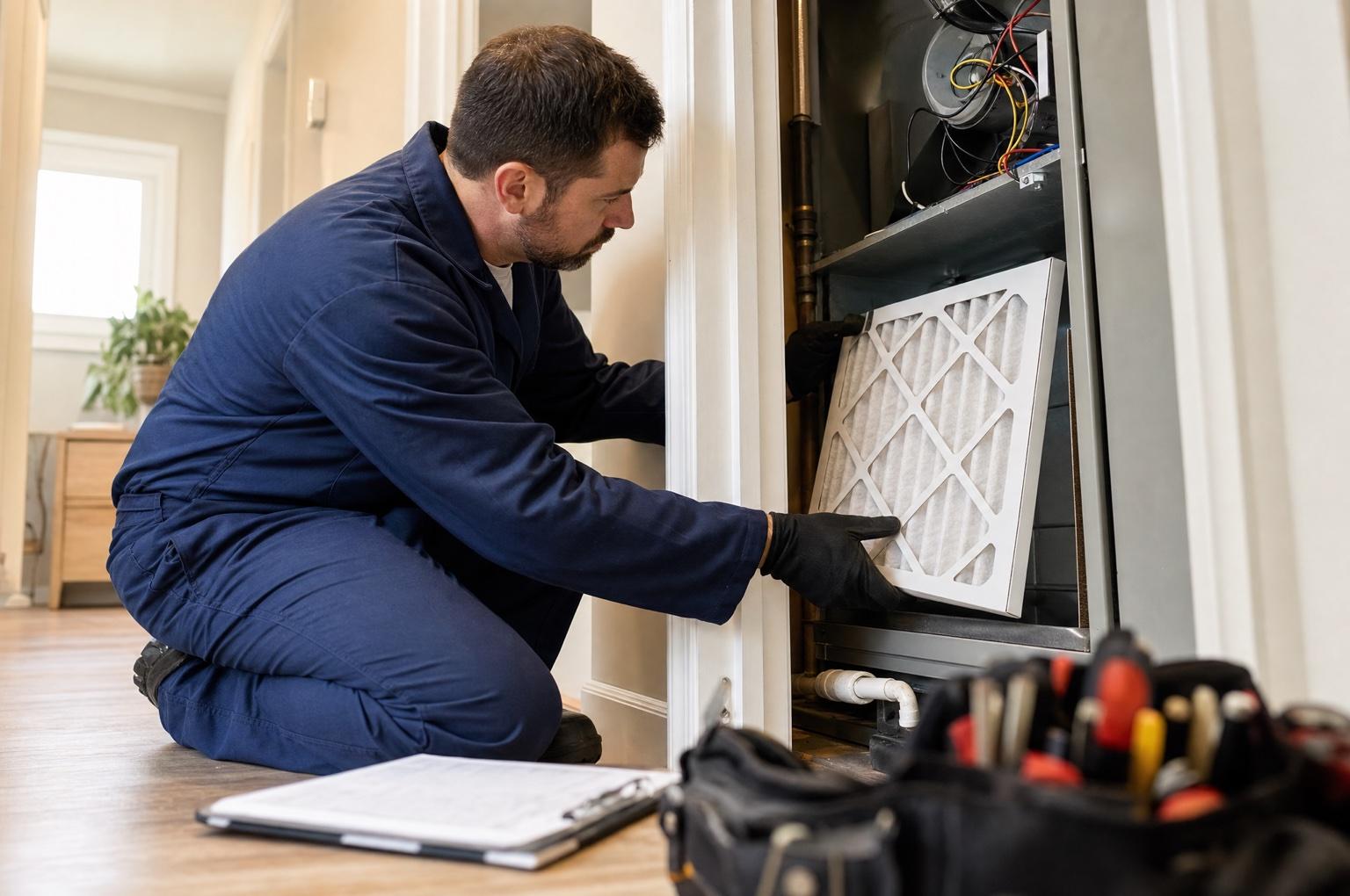
Filters, thermostats, condensate lines, coil surfaces, belts, and airflow complaints make up a huge share of day-to-day HVAC and building-maintenance work — none of it requires touching refrigerant, and all of it is covered here.
Speak the trade's language
CFM, static pressure, delta-T, single-stage vs. two-stage, furnaces vs. heat pumps, MERV ratings — when you use the right words for what you see, technicians, supervisors, and customers take you seriously.
Build an honest path toward EPA 608 and licensing
The course closes with the real legal landscape: what work requires EPA Section 608 certification or a state license, who administers those credentials, and the sensible order to pursue them — so you invest in the right next step, not rumors.
Curriculum
Inside the HVAC Fundamentals course
8 self-paced lessons, then a 20-question exam — 75% to pass, unlimited retries. Exam questions are drawn from a larger question pool, so every retry gets a fresh set.
- 1
Lesson 1: How HVAC Systems Work — Split Systems, Packaged Units, Heat Pumps, Furnaces, and Boilers
Everything in this trade gets easier once you let go of one wrong idea: air conditioners do not make cold, and heat pumps do not make heat from nothing. They move heat from one place to another. Cooling a house means collecting heat from the indoor air and dumping it outdoors. Heating with a heat pump means collecting heat from the outdoor air — yes, even cold winter air holds heat — and moving it inside. Once you see every system as a heat-moving machine, the equipment stops being a set of mysterious boxes and becomes stops along a route.
- 2
Lesson 2: Airflow and Ductwork — Returns, Supplies, Static Pressure, and Why Systems Suffocate
A forced-air system is a loop, not a fountain. The blower pulls air out of the house through return grilles and ducts, drags it through the filter, pushes it across the coil or heat exchanger, and sends it back out through supply ducts to the registers. Same air, around and around. That single fact drives the most useful rule in this lesson: the system can only push out as much air as it can pull back in. Starve the return side and the supply side dies with it.
- 3
Lesson 3: Thermostats and Controls — Calls for Heat and Cool, Staging, and Safe Checks
A thermostat is a switch, not a throttle. It compares the room temperature to the setpoint and, when they disagree enough, closes a circuit that tells the equipment to run. That is a call: a call for heat, a call for cooling, a call for fan. When the setpoint is satisfied, the circuit opens and the equipment stops. This is why cranking a thermostat way down does not cool a house faster — on single-stage equipment the system runs at exactly one output no matter how dramatic the setpoint. It just runs longer, and often past the point anyone wanted.
- 4
Lesson 4: Filters and Indoor Air Quality Basics
Ask most people what a furnace filter is for and they will say clean air. That is its second job. Its first job is protecting the equipment: keeping dust, hair, and debris out of the blower wheel and off the indoor coil. A dust-caked blower moves less air. A matted coil is worse — it insulates the very surface that is supposed to transfer heat and strangles airflow at the same time. Everything you learned in the airflow lesson funnels through this one cardboard frame. The filter is the cheapest component in the system, and it decides the fate of the expensive ones.
- 5
Lesson 5: Electrical Safety Basics Around HVAC Equipment
This lesson will not teach you to work on electrical components, because that is not your job, and pretending otherwise gets people hurt. It teaches you to work near electricity without becoming part of the circuit, and to recognize exactly where maintenance ends and electrical work begins. Awareness is the skill. The bright line is the deliverable.
- 6
Lesson 6: Routine Maintenance and Inspection — the Non-Refrigerant Work That Keeps Systems Alive
Most of what keeps HVAC equipment alive has nothing to do with refrigerant. It is a boring, repeatable loop — filters, water management, clean coil surfaces, clear space, and paying attention — and it is entirely legal for a helper or maintenance tech to perform. Done consistently, this loop prevents the majority of expensive failures. Done never, it manufactures them. This lesson is the loop.
- 7
Lesson 7: Customer Communication and Documentation
Technical skill gets you hired. Communication and paperwork are what keep customers, protect you when things go sideways, and make licensed techs glad to work with you. This is the lesson most training skips, and it is the one that will follow you through every trade you ever touch.
- 8
Lesson 8: The Legal Landscape — EPA Section 608, State Licensing, and What This Course Is Not
You now know enough to be useful, so this final lesson draws the legal map plainly — what federal law says, what states add, what this course's certificate is, and what it is not. Clear lines here protect you, your employer, and your customers, and they make your next career moves obvious.
Curriculum
What you’ll learn
- Identify the major residential and light-commercial system types — split systems, packaged units, heat pumps, furnaces, and boilers — and explain how each moves and conditions air.
- Trace the airflow path through returns, filters, blowers, coils, supply ducts, and registers, and recognize the symptoms of restricted airflow and duct leakage.
- Explain how thermostats and basic controls call for heating and cooling, and safely check settings, batteries, and programming without opening line-voltage equipment.
- Select, size, and replace air filters correctly, and explain MERV ratings and the filter's role in indoor air quality and equipment protection.
- Apply electrical safety basics around HVAC equipment — lockout awareness, disconnect switches, capacitor hazards, and the strict boundary between helper tasks and licensed electrical work.
- Perform and document routine non-refrigerant maintenance: filter changes, condensate drain care, coil surface cleaning, belt and visual inspections, and outdoor-unit clearance.
- Communicate professionally with customers and document findings, recommendations, and completed work so a supervisor or licensed tech can act on them.
- Explain what EPA Section 608 certification and state HVAC licensing legally cover, who administers them, and which tasks this course does and does not qualify you to perform.
What's included
Everything you get with enrollment
One price — the course, the exam, the certificate, and the tools to put it to work.
Self-paced lessons
Guided lessons with key points, safety callouts, real job scenarios, and practice checks — about 2–3 focused hours.
A real certification exam
A 20-question exam drawn from a larger question pool — 75% to pass, and every retry gets fresh questions.
Professional field documents
Branded checklists, customer agreements, and job logs printed with your company letterhead — unlocked when you pass.
Instant, verifiable certificate
Pass and download your Certificate of Completion the same day — with a unique ID anyone can confirm online.
2-year validity + renewal
Your credential is valid for two years, with a simple renewal path before it expires.
Free Find-a-Pro listing
Once certified, claim a free listing so homeowners in your area can hire you.
The process
How it works
Enroll & pay
Secure checkout, instant course access.
Complete the course + pass the exam
Guided lessons with real job scenarios, then a 20-question exam — 75% to pass, unlimited retries.
Download your certificate
Personalized certificate generated instantly, with a unique verification ID.
Your credential
Your certificate
- Holder name and course title
- Unique certificate ID
- Issue date and expiry date (2-year validity)
- Online verification by ID
A NISCR Certificate of Completion confirms completion of NISCR training and examination. It is a professional credential, not a government license. Where local law requires a license to perform a service, the technician is responsible for obtaining it.
Certificate
of Completion
This certifies that
Your Name
has completed
HVAC Fundamentals
- Certificate No.
- Valid
- NISCR-HVF-2026-XXXXXX
- 2 years
Enroll
Enroll today
$199
Course + certificate + a simple renewal option.
Try it risk-free for 3 days — full refund before you begin the final exam.
Keep going
Related courses
Questions
Frequently asked questions
- Is this a license or an EPA certification?
- No. A NISCR Certificate of Completion is a professional training credential, not a government license and not an EPA credential. Handling refrigerants legally requires passing the EPA Section 608 exam, which is administered by EPA-approved certifying organizations, and many states require an HVAC contractor or mechanical license for installation and repair work. This course prepares you for the non-refrigerant work that does not require those credentials — and teaches you exactly how to pursue them when you are ready.
- Who is this course for?
- Helpers and apprentices joining HVAC crews, building-maintenance and facilities staff who care for equipment between technician visits, handymen who want to handle filters, thermostats, and airflow issues competently, and anyone considering the HVAC trade who wants a solid, honest foundation before committing to EPA 608 testing or a licensing path.
- Does this course teach refrigerant work?
- No — deliberately. Recovering, charging, or otherwise handling regulated refrigerants without EPA Section 608 certification is illegal, so this course stays firmly on the non-refrigerant side: system knowledge, airflow, controls, filters, electrical safety awareness, and maintenance. It explains what refrigerant does inside the system so you understand what you are looking at, and it tells you plainly how the real EPA 608 exam works when you want to go further.
- How fast do I get the certificate?
- The same day. After you complete the coursework and pass the exam — 20 questions drawn from a larger question pool, with a 75% pass mark and unlimited retries, each retry drawing a fresh set of questions — your Certificate of Completion is issued immediately with a unique ID anyone can verify online.
- Will this help me get an HVAC job?
- It helps you show up as a serious candidate. Employers hiring helpers and maintenance staff mostly want proof you understand the basics, respect safety boundaries, and will not damage equipment or reputations. A verifiable credential covering system types, airflow, controls, filters, and safe maintenance is exactly that proof — though hiring decisions, pay, and advancement always depend on the employer and your work.
- Is the course self-paced?
- Yes. The course is fully online and self-paced — start, stop, and resume on any device. Most students finish the eight lessons in about two and a half hours, then take the exam whenever they feel ready.