
Track C · DVI
Dryer Vent Installation Certification
The NISCR Dryer Vent Installation Certification is a $199 online, self-paced course — 8 lessons (≈2.5 hours) with a 20-question exam; pass and download a verifiable certificate the same day, valid 2 years.
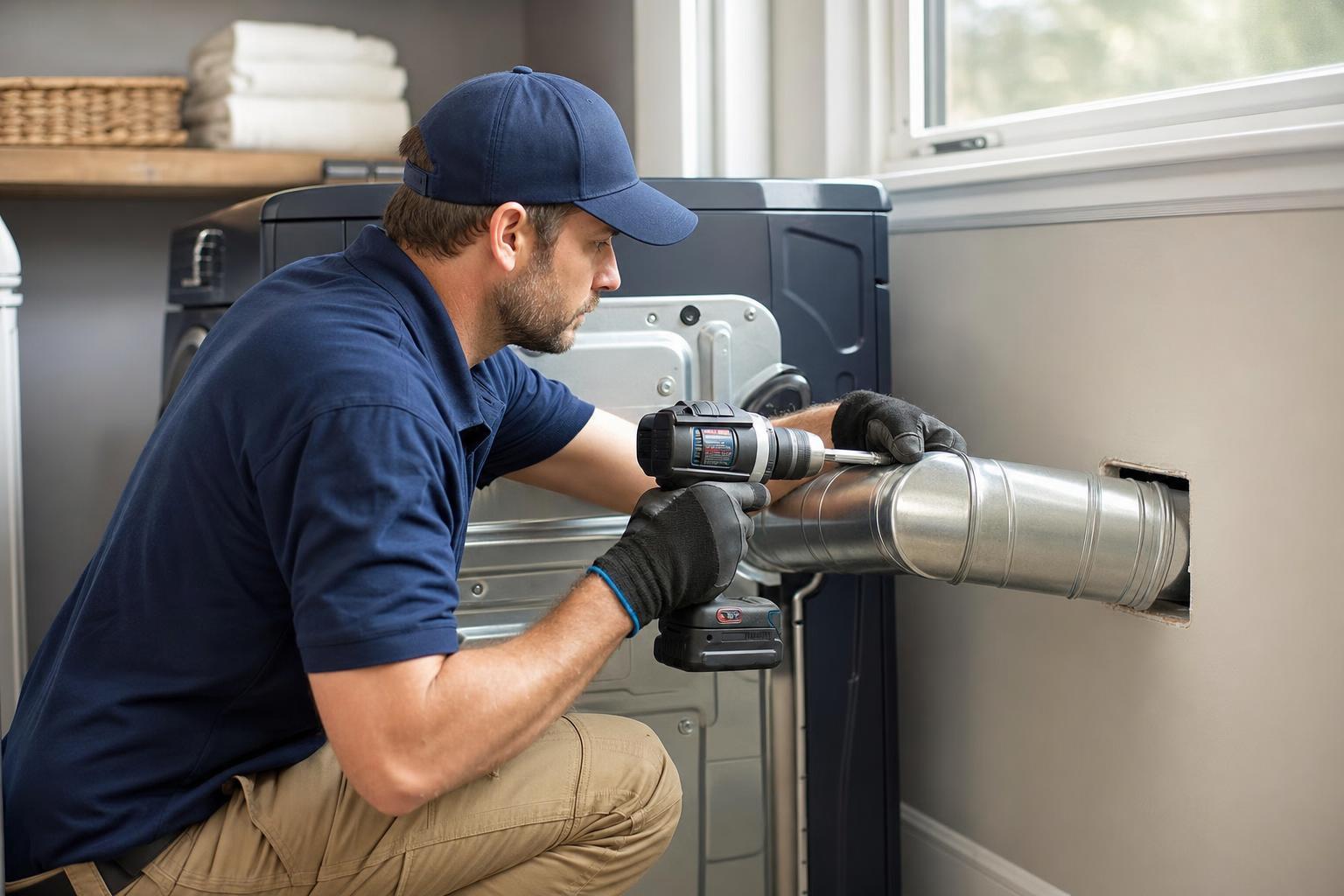
Learn the code-compliant method for designing, rerouting, and installing dryer vent systems with rigid duct and proper exterior termination — and prove your skill with a verifiable certificate you can show homeowners and builders.
- Self-paced
- Instant certificate
- 2-year validity
- Format
- Online, self-paced
- Lessons
- 8 lessons
- Time
- ≈2.5 hours
- Exam
- 20 questions
- Pass mark
- 75% · retries
- Documents
- 3 included
- Certificate
- Same day
- Validity
- 2 years
Earning potential
How much can you earn?
Per installation
$150–500
Bundled with a cleaning
$250–700
New-construction rough-in (per unit)
$200–450
Illustrative ranges — actual earnings vary by location, effort, and experience, and are not guaranteed.
Why it pays
Why get certified?
Win builder and GC contracts
General contractors hire vent installers who can show their rough-ins meet code and pass inspection the first time.
Bundle every cleaning into an upsell
A certified installer can convert a clogged or flex-duct system into a paid rigid-duct reroute instead of just clearing it.
Reduce callbacks and liability
Documenting compliant duct length, termination, and clearances protects you when a fire or moisture claim is investigated.
Charge for expertise, not just labor
A credential lets you quote reroutes and corrections at a premium over handymen who only run flex pipe.
Curriculum
Inside the Dryer Vent Installation course
8 self-paced lessons, then a 20-question exam — 75% to pass, unlimited retries. Exam questions are drawn from a larger question pool, so every retry gets a fresh set.
- 1
Lesson 1: Assessing the Job — Dryers, Ducts, and What Is at Stake
A clothes dryer does a demanding job: it pushes hot, moisture-laden air loaded with combustible lint out of the building, every load, for years. When the exhaust path is right, that air leaves the home in seconds. When it is wrong — too long, too rough, terminated indoors, or screened shut — lint settles out of the slowing airstream, airflow collapses, drying times stretch, and the appliance runs hotter and hotter over a growing bed of fuel. Restricted and failed dryer exhaust is a leading cause of dryer fires. The second hazard is quieter: every load sends a surprising quantity of water out of the laundry as vapor, and vapor released into an attic, crawlspace, or wall cavity condenses on cold framing, where it feeds mold and rot for years before anyone notices.
- 2
Lesson 2: Safety on the Installation
Dryer vent work looks tame next to heavy construction, but it stacks real hazards: 240-volt circuits, gas connections, blind cuts into finished walls, attic heat, razor-edged sheet metal, and lint — which is, never forget, a fine and eager fuel. The professional habit is a deliberate hazard review before tools come out, repeated whenever the job moves to a new work area.
- 3
Lesson 3: Airflow and the Length Budget
A residential dryer moves its exhaust with a modest blower, and every inch of duct spends some of that blower's limited pressure. Air dragging along duct walls loses energy to friction; air forced around a bend loses far more to turbulence. When the total resistance climbs past what the blower can overcome, velocity falls, lint drops out of the slowing airstream, the fallen lint raises resistance further, and the system spirals toward blockage. That spiral is why the code limits how long a dryer duct may be — and why you calculate the length before you buy a single fitting.
- 4
Lesson 4: Materials, Tools, and Inspecting What Is Already There
The material rules for dryer exhaust exist for one reason: lint. A smooth metal interior lets lint ride the airstream all the way outdoors; every ridge, seam gap, and protruding point gives it somewhere to land. Once you understand that, the whole material list makes sense.
- 5
Lesson 5: Routing Decisions and Rerouting Non-Compliant Runs
Routing is the highest-leverage decision on the job. Every later step — materials, labor, airflow, inspection — inherits the route, and the route is governed by one hierarchy: the shortest, straightest path to the outdoors wins. Prefer a sidewall termination over a roof cap when geometry allows, because sidewalls are easier to flash, easier to service, and free of ice problems. Prefer routes through conditioned space over long attic or crawlspace passages, because cold duct condenses the warm exhaust inside itself. And prefer routes whose joints stay accessible — a basement ceiling beats a closed wall chase when both reach the same wall.
- 6
Lesson 6: Assembly — Joints, Support, Slope, and Penetrations
Assembly is where a correct plan becomes a correct system — or quietly stops being one. The rules in this lesson all serve the same master as the material rules: keep the interior smooth, sealed, and continuously downhill toward the outdoors, with nothing for lint to catch on.
- 7
Lesson 7: Termination and Airflow Verification
The termination is where more installations fail than anywhere else, and it is also where the whole system finally gets proven. Treat this stage as two disciplines: install the cap correctly, then verify the system with measurements instead of optimism.
- 8
Lesson 8: Completion, Documentation, and the Handoff
An installation ends twice: once when the airflow verifies, and again when the paperwork proves it. The second ending is the one that wins builder contracts, passes inspections without return trips, and protects you if a fire or moisture claim ever puts your work under a magnifying glass. Treat documentation as part of the installation, not an accessory to it.
Curriculum
What you’ll learn
- Calculate maximum allowable duct length and deduct equivalent length for each elbow to keep runs within code.
- Select and join rigid metal duct, transition duct, and connectors that meet UL 2158A and manufacturer specifications.
- Reroute existing flex or non-compliant runs to a shorter, straighter path that improves airflow and drying time.
- Install a code-compliant exterior termination with a backdraft damper and no screen to prevent lint buildup and pest entry.
- Seal joints with foil tape or approved fasteners while avoiding sheet-metal screws that snag lint inside the duct.
- Maintain required clearances and proper slope when running duct through walls, ceilings, attics, and crawlspaces.
- Set up a booster fan and condensate management for long or below-grade runs that exceed standard length limits.
- Verify airflow and damper operation at completion and document the finished system for the homeowner or inspector.
What's included
Everything you get with enrollment
One price — the course, the exam, the certificate, and the tools to put it to work.
Self-paced lessons
Guided lessons with key points, safety callouts, real job scenarios, and practice checks — about 2–3 focused hours.
A real certification exam
A 20-question exam drawn from a larger question pool — 75% to pass, and every retry gets fresh questions.
Professional field documents
Branded checklists, customer agreements, and job logs printed with your company letterhead — unlocked when you pass.
Instant, verifiable certificate
Pass and download your Certificate of Completion the same day — with a unique ID anyone can confirm online.
2-year validity + renewal
Your credential is valid for two years, with a simple renewal path before it expires.
Free Find-a-Pro listing
Once certified, claim a free listing so homeowners in your area can hire you.
The process
How it works
Enroll & pay
Secure checkout, instant course access.
Complete the course + pass the exam
Guided lessons with real job scenarios, then a 20-question exam — 75% to pass, unlimited retries.
Download your certificate
Personalized certificate generated instantly, with a unique verification ID.
Your credential
Your certificate
- Holder name and course title
- Unique certificate ID
- Issue date and expiry date (2-year validity)
- Online verification by ID
A NISCR Certificate of Completion confirms completion of NISCR training and examination. It is a professional credential, not a government license. Where local law requires a license to perform a service, the technician is responsible for obtaining it.

Certificate
of Completion
This certifies that
Your Name
has completed
Dryer Vent Installation

- Certificate No.
- Valid
- NISCR-DVI-2026-XXXXXX
- 2 years
Enroll
Enroll today
$199
Course + certificate + a simple renewal option.
Try it risk-free for 3 days — full refund before you begin the final exam.
Keep going
Related courses
Questions
Frequently asked questions
- Is this a license?
- No. This is a professional certification from NISCR, not a government-issued license. It verifies that you have been trained in and tested on the standards-based process for code-compliant dryer vent installation.
- How fast do I get the certificate?
- Same day. Once you complete the course and pass the exam — 20 questions drawn from a larger question pool, with a 75% pass mark and unlimited retries, each retry drawing a fresh set of questions — your certificate is issued immediately and is available to download and share.
- Does my state require a license for this work?
- It varies. Some areas require a general contractor, mechanical, or specialty trade license to perform or pull permits for duct work, while others do not. Check your state and local building department. This credential adds to those requirements — it does not replace a required license.
- Why does dryer vent installation need to be code-compliant?
- Lint catches fire easily, and poorly installed vents are a leading cause of dryer fires. Codes limit duct length, ban screws and screens that trap lint, and require rigid duct and proper termination — this course teaches you to install to those rules.
- Does this cover rerouting and not just new installs?
- Yes. The course covers diagnosing and rerouting existing non-compliant or flex-duct runs to a shorter, straighter rigid path, which is some of the most common and highest-value vent work you will quote.
- Do I need prior trade experience to take this?
- No prior certification is required. Basic comfort with hand tools and home construction helps, but the course teaches the full process from duct sizing and material selection through termination and final airflow verification.