
Track C · GDR
Garage Door Repair & Installation Certification
The NISCR Garage Door Repair & Installation Certification is a $199 online, self-paced course — 8 lessons (≈2.5 hours) with a 20-question exam; pass and download a verifiable certificate the same day, valid 2 years.
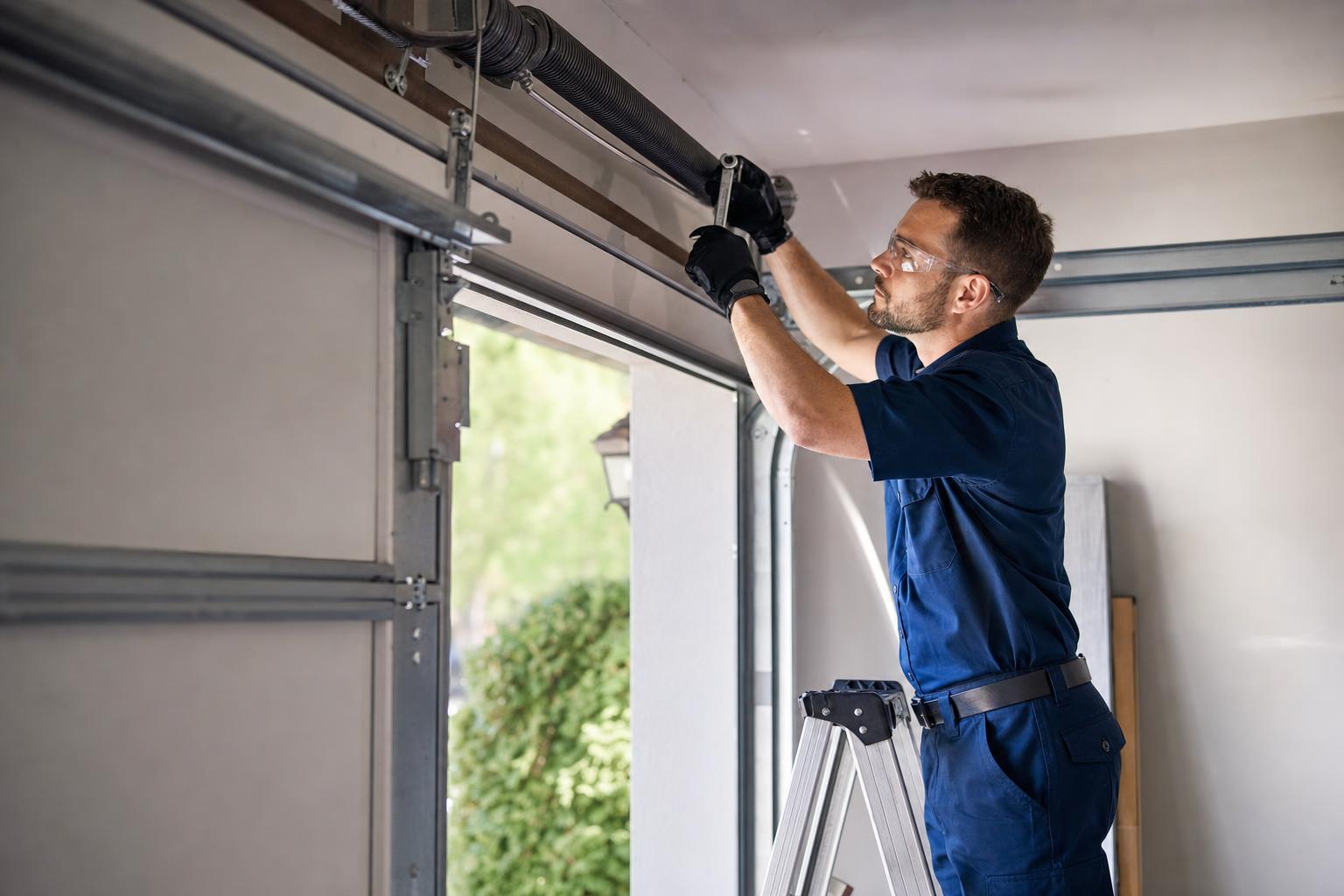
Learn the standards-based process for diagnosing and repairing garage door springs, openers, tracks, and panels — and back it with a credential homeowners and property managers can verify before they let you near a door under tension.
- Self-paced
- Instant certificate
- 2-year validity
- Format
- Online, self-paced
- Lessons
- 8 lessons
- Time
- ≈2.5 hours
- Exam
- 20 questions
- Pass mark
- 75% · retries
- Documents
- 3 included
- Certificate
- Same day
- Validity
- 2 years
Earning potential
How much can you earn?
Service call / repair
$150–400
Full door installation
$400–1,500+
Demand
high, year-round
Illustrative ranges — actual earnings vary by location, effort, and experience, and are not guaranteed.
Why it pays
Why get certified?
Charge for expertise, not guesswork
A verifiable certificate and standards-based training help you justify service-call and installation rates that DIY competitors and unproven handymen can't.
Prove you handle springs safely
Torsion and extension springs store enough energy to cause serious injury — certification shows customers and partners you follow a documented safe-release procedure.
Win builder and property-manager accounts
When contractors and property managers screen installers, you can show standards-based training on file and a certificate they can verify.
Stand out in a trust-driven trade
Homeowners hand over a key and a security risk; a verifiable certificate turns a stranger into a credentialed pro.
Cut callbacks and warranty disputes
Knowing correct spring sizing, opener force settings, and track alignment means fewer return trips and cleaner manufacturer warranty claims.
Curriculum
Inside the Garage Door Repair & Installation course
8 self-paced lessons, then a 20-question exam — 75% to pass, unlimited retries. Exam questions are drawn from a larger question pool, so every retry gets a fresh set.
- 1
Lesson 1: Reading the Door as a System — Assessment and Measurement
Every garage door call begins before you touch a tool: you read the door as a balanced mechanical system. A residential sectional door typically weighs 130 to 350 pounds depending on size, material, and insulation, yet a healthy one lifts with only a few pounds of effort. The difference is the counterbalance — a spring system tensioned to offset the door's weight so precisely that the opener, or a person, moves only the small remainder. Nearly every symptom you will be called for — a straining opener, a door that slams shut, a door hanging crooked in its tracks — traces back to how well that balance is holding.
- 2
Lesson 2: Stored Energy — Spring, Electrical, and Site Safety
Garage door work injures technicians in one main way: stored energy released without control. A wound torsion spring holds the energy needed to lift a two-hundred-pound door through seven feet of travel, concentrated in a coil of steel inches from your face while you work. Extension springs hold the same energy stretched along the tracks. Cables, drums, and bottom brackets all carry that tension out to the door. None of it looks dangerous standing still — which is why the professional habit is absolute: treat every spring, cable, and tensioned bracket as loaded until you have personally verified otherwise.
- 3
Lesson 3: Counterbalance Science — Spring Sizing, Turns, and Cycle Life
Springs are sized, not chosen. The counterbalance works only when the torque a wound spring delivers to the shaft — and through the drums to the cables — matches the door's weight closely through its whole travel. A spring only slightly too light leaves the opener hauling real weight every cycle until it fails early; a spring too heavy throws the door upward and slams it into the stops. The trade sizes springs from three anchors — the door's actual weight, the drum size, and the spring's dimensions — and this lesson is about getting those anchors right instead of guessing from door size alone.
- 4
Lesson 4: Point-by-Point Inspection — Cables, Drums, Rollers, Tracks, and Hinges
Most 'opener problems' and 'spring problems' are neither: they are a five-dollar roller, a loose track bracket, or a fraying cable announcing itself. The habit that catches them is a point-by-point inspection of the whole load path, in the same order, on every service call — not just around the part the customer complained about. The door is one system, and a defect anywhere loads everything else harder.
- 5
Lesson 5: Repair or Replace — Making the Call and Quoting It Honestly
Repair-or-replace is where technical judgment meets honesty, and the trade rewards a consistent framework over gut feel. Four questions decide most calls: Is the component safe to leave in service? Are correct parts still available? Where is the cost crossover between fixing this piece and renewing the assembly? And how much life remains in everything around it? A cheap repair bolted to a dying system is not a favor to the customer — but neither is replacing a door that needed one section and a set of rollers.
- 6
Lesson 6: Full Installation — Opening Prep Through First Lift
A full installation is a sequence, and the sequence exists because each step creates the reference for the next. It starts before any hardware: verify the opening. Measure width and height in at least three places each, check the jambs for plumb and the header for level, and check the floor for slope across the opening. Measure headroom, sideroom, and backroom, and compare each against the spec sheets for the exact track radius and opener you plan to hang — standard-radius track and a trolley opener need clearances that a low-headroom kit or a wall-mount opener can relax. Finding a missing inch now costs a phone call; finding it after the sections are stacked costs the afternoon.
- 7
Lesson 7: Opener Safety Systems — Limits, Force, and the Tests That Prove Them
The opener is the smallest lifter on the job — the springs carry the weight; the opener supplies travel, control, and, most importantly, the safety systems that decide whether a closing door hurts someone. Residential openers in the United States have been required to include entrapment protection — a monitored photo-eye system plus contact reversal — under federal safety requirements in effect since 1993. Commissioning an opener means making those systems prove themselves, on this door, today. An opener that runs is unremarkable; an opener that reverses when it must is what you are being paid to leave behind.
- 8
Lesson 8: Handoff, Documentation, and the Service Record
A garage door job ends twice: once when the hardware works, and again when the customer understands it and the paperwork proves it. The second ending is the one that protects you. Doors and openers live for years after you drive away, and when something goes wrong later, the questions are always the same — what did you do, what did you test, and what did you tell them. The handoff and the file are how those questions get answered in your favor.
Curriculum
What you’ll learn
- Measure and select the correct torsion or extension spring by wire size, inside diameter, and length, then wind it to the right turn count.
- Safely de-tension and replace a broken spring using winding bars and a controlled-release procedure.
- Diagnose opener faults across chain-, belt-, and screw-drive units, from logic-board failures to worn gears and bad capacitors.
- Set and test opener travel limits and force adjustments so the door reverses correctly under load.
- Inspect, align, and replace bent or rusted track sections and rollers to restore smooth, quiet travel.
- Replace damaged panels and re-balance a sectional door so it holds position anywhere in its travel.
- Test and adjust safety systems — photo-eye sensors and auto-reverse — to meet UL 325 entrapment-protection requirements.
- Plan and complete a full sectional door installation: leveling tracks, mounting the operator, and balancing the finished door.
What's included
Everything you get with enrollment
One price — the course, the exam, the certificate, and the tools to put it to work.
Self-paced lessons
Guided lessons with key points, safety callouts, real job scenarios, and practice checks — about 2–3 focused hours.
A real certification exam
A 20-question exam drawn from a larger question pool — 75% to pass, and every retry gets fresh questions.
Professional field documents
Branded checklists, customer agreements, and job logs printed with your company letterhead — unlocked when you pass.
Instant, verifiable certificate
Pass and download your Certificate of Completion the same day — with a unique ID anyone can confirm online.
2-year validity + renewal
Your credential is valid for two years, with a simple renewal path before it expires.
Free Find-a-Pro listing
Once certified, claim a free listing so homeowners in your area can hire you.
The process
How it works
Enroll & pay
Secure checkout, instant course access.
Complete the course + pass the exam
Guided lessons with real job scenarios, then a 20-question exam — 75% to pass, unlimited retries.
Download your certificate
Personalized certificate generated instantly, with a unique verification ID.
Your credential
Your certificate
- Holder name and course title
- Unique certificate ID
- Issue date and expiry date (2-year validity)
- Online verification by ID
A NISCR Certificate of Completion confirms completion of NISCR training and examination. It is a professional credential, not a government license. Where local law requires a license to perform a service, the technician is responsible for obtaining it.

Certificate
of Completion
This certifies that
Your Name
has completed
Garage Door Repair & Installation

- Certificate No.
- Valid
- NISCR-GDR-2026-XXXXXX
- 2 years
Enroll
Enroll today
$199
Course + certificate + a simple renewal option.
Try it risk-free for 3 days — full refund before you begin the final exam.
Keep going
Related courses
Questions
Frequently asked questions
- Is this a government license?
- No. NISCR certification is a professional credential that documents you've completed standards-based training and passed an assessment for garage door repair and installation. It is not a state or municipal license. It is proof of training customers, property managers, and partners can check at niscr.com/verify.
- How fast do I get my certificate?
- The same day. Once you finish the course and pass the exam — 20 questions drawn from a larger question pool, with a 75% pass mark and unlimited retries, each retry drawing a fresh set of questions — your certificate is issued immediately and ready to download, print, and share.
- Does my state require a license for this work?
- It varies. Some states and municipalities require a contractor or specialty license to perform or advertise garage door work, while others don't. Always check your local requirements — this certification adds to a required license but does not replace one.
- Do I need experience to take this course?
- No prior certification is required. The course is built for both newcomers and working techs who want to formalize their skills, covering springs, openers, tracks, panels, and safety from the ground up.
- Does it cover both torsion and extension spring systems?
- Yes. You'll learn to identify, size, and safely service both torsion springs and extension springs, including the winding and controlled-release procedures each system requires.
- Will this help me win installation and contract work?
- It can help, but requirements vary. Some builders, property managers, and warranty programs require a specific credential or license; NISCR's Certificate of Completion is independent and does not replace one where it is required. What it gives you is documented, verifiable training you can show when you bid on higher-value installation and repeat-account work.