Track C · EPP
EPA 608 Exam Prep
NISCR EPA 608 Exam Prep is a $199 online, self-paced preparation course — 12 lessons (≈4 hours) with a 20-question practice exam; pass and download a Certificate of Completion for the prep coursework the same day.
Study for the EPA Section 608 technician exam the smart way — Core concepts plus Type I, Type II, and Type III material taught in plain English, with practice questions that make the real thing feel familiar. This is a preparation course: the actual Section 608 exam is administered by EPA-approved certifying organizations, and this course gets you ready to pass it.
- Self-paced
- Instant certificate
- 2-year validity
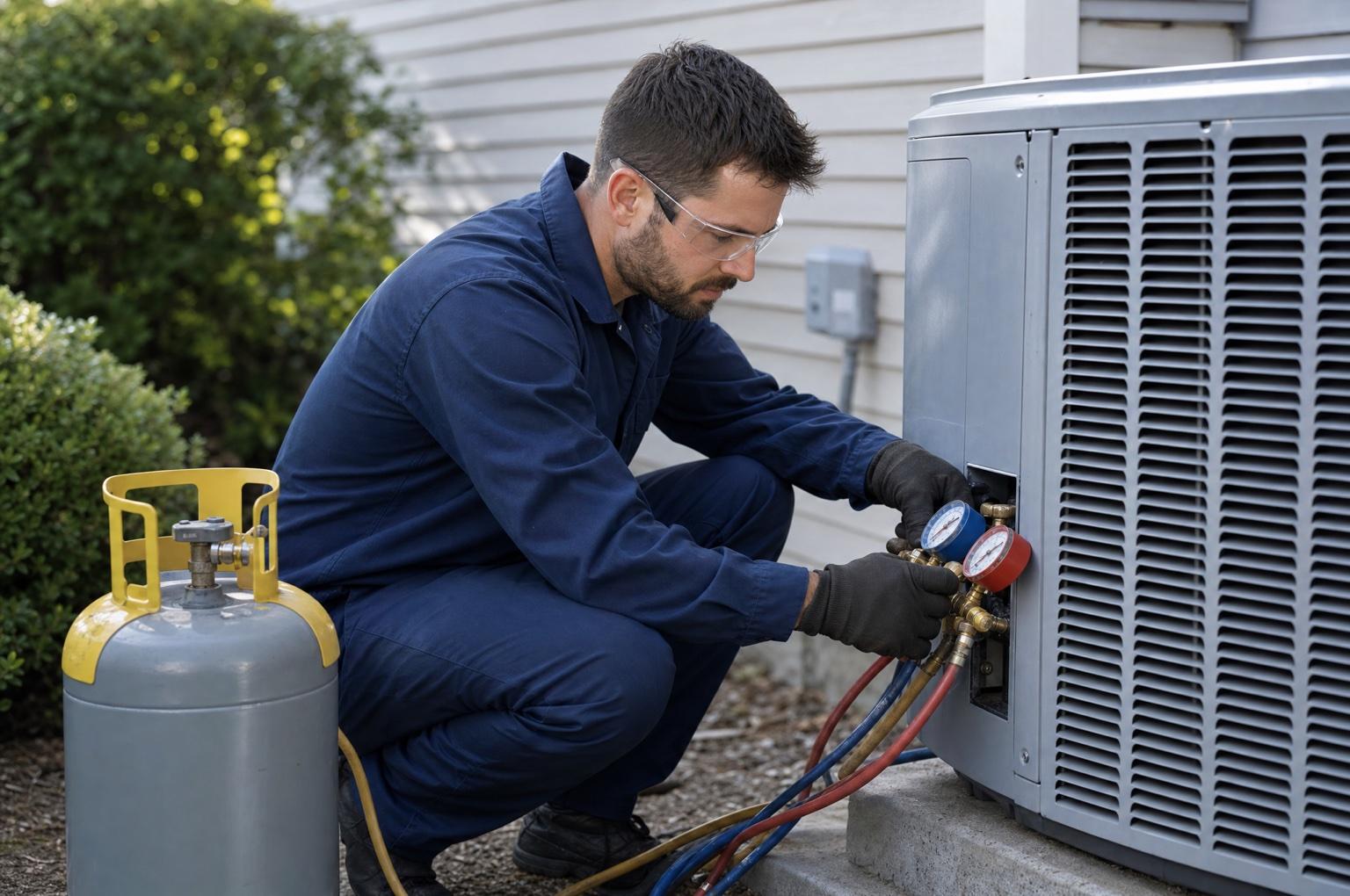
This is exam preparation — not EPA certification
NISCR does not administer the EPA Section 608 exam and cannot issue EPA Section 608 certification. The real exam is administered by EPA-approved certifying organizations, and only passing it with one of those organizations makes you a certified Section 608 technician. This course prepares you for that exam — like an SAT prep course prepares you for the SAT.
Completing this course earns a NISCR Certificate of Completion for the preparation coursework only. It does not qualify you to perform licensed HVAC work or handle refrigerants, and it is not a substitute for the Section 608 credential or any state HVAC license.
- Format
- Online, self-paced
- Lessons
- 12 lessons
- Time
- ≈4 hours
- Exam
- 20 questions
- Pass mark
- 75% · retries
- Documents
- 3 included
- Certificate
- Same day
- Validity
- 2 years
Earning potential
How much can you earn?
Why techs take the 608 exam
refrigerant work legally requires it
HVAC technician median pay
~$59k / year (BLS)
Course + exam-fee outlay
typically under $350 total
Illustrative ranges — actual earnings vary by location, effort, and experience, and are not guaranteed.
Why it pays
Why prep with NISCR?
Walk in knowing what the exam asks
The Section 608 exam covers Core plus the Type sections you choose — ozone and climate rules, recovery and reclamation, cylinders and safety, and equipment-specific procedures. This course organizes all of it so nothing on test day is a surprise.
Learn concepts, not memorized trivia
Rules stick when you understand why they exist. Each lesson explains the reasoning — why refrigerants are regulated, why recovery levels differ by equipment type, why system pressure changes the procedure — so the answers become obvious instead of memorized.
Practice until the format feels familiar
Lesson self-checks plus a large pool of original practice questions in the same multiple-choice style train you to read questions carefully and eliminate wrong answers — the core skill of any certification-style exam.
Know exactly what to do after you pass here
The final lesson walks through scheduling the real exam with an EPA-approved certifying organization, what the fee typically covers, which Type sections to sit for, and what your wallet card means for employment — so your momentum carries straight through to the real credential.
Curriculum
Inside the EPA 608 Exam Prep course
12 self-paced lessons, then a 20-question exam — 75% to pass, unlimited retries. Exam questions are drawn from a larger question pool, so every retry gets a fresh set.
- 1
Lesson 1: How EPA Section 608 Certification Works — Types, the Exam, and Who Administers It
In 1990, Congress amended the Clean Air Act to deal with a problem atmospheric scientists had spent two decades confirming: chlorine-bearing refrigerants drifting into the stratosphere were destroying the ozone layer that shields the planet from ultraviolet radiation. Section 608 of that law told the EPA to build a national program around one core idea — refrigerant belongs inside equipment or inside approved containers, never in the open air. Every rule in this course and every question on the exam flows from that one law and that one idea.
- 2
Lesson 2: Refrigerants, the Ozone Layer, and Climate Rules — the Why Behind Everything (Core)
A big slice of the Core exam is atmosphere science, and there is a reason: every regulation you must follow exists because of what refrigerants do when they escape. Understand the why and the rules stop being trivia — they become obvious. This lesson gives you the story that makes the rest of the material stick.
- 3
Lesson 3: The Three R's — Recovery, Recycling, and Reclamation (Core)
Recover, recycle, reclaim. Three words that sound interchangeable in casual shop talk — and three precisely different things in the regulations. The Core exam leans hard on these definitions because the entire refrigerant stewardship system is built on them. Learn them exactly, and learn why the lines sit where they do.
- 4
Lesson 4: Cylinders, Safety, and Shipping (Core)
Refrigerant cylinders are the most dangerous objects you will handle in this trade, and the Core exam treats them accordingly. A cylinder is a pressure vessel riding around in a hot van; respect it and it is routine equipment, disrespect it and it is a bomb with a valve. This lesson covers the rules and — more importantly — the physics behind them.
- 5
Lesson 5: Type I — Small Appliances
Type I is the certification for small appliances, and the definition is exact enough to memorize word for word: a small appliance is a product that is fully manufactured, charged, and hermetically sealed at the factory, and that contains 5 pounds or less of refrigerant. Both halves matter. Sealed at the factory rules out field-assembled equipment; 5 pounds or less rules out anything with a serious charge. What fits: household refrigerators and freezers, window air conditioners, dehumidifiers, vending machines, water coolers, under-counter ice makers. What this category covers, in other words, is the enormous river of consumer appliances that eventually flows to the scrapyard — which is why Type I work is dominated by recovery before disposal.
- 6
Lesson 6: Type II — High-Pressure Appliances
Type II is where most working technicians live. It covers high-pressure appliances — equipment using refrigerants that operate at high pressure, which in practice means the bulk of the field: residential and commercial split-system air conditioners, heat pumps, rooftop package units, and most commercial refrigeration. If you service comfort cooling for a living, Type II is your certification, and the exam knows it — this section tests real service situations.
- 7
Lesson 7: Type III — Low-Pressure Appliances
Type III covers low-pressure appliances — in practice, the large centrifugal chillers that cool hospitals, high-rises, campuses, and industrial plants. These machines use low-pressure refrigerants and hold a distinction that reorganizes everything you know about refrigerant work: during normal operation, much of the machine runs below atmospheric pressure. A low-pressure chiller operates in a vacuum. Once that fact lands, the whole Type III exam becomes a series of logical consequences.
- 8
Lesson 8: Test Day — Strategy, Booking the Real Exam, and What Happens After You Pass
You have the knowledge. This final lesson is about converting it into a passing score on the real Section 608 exam — and about the practical steps between finishing this course and holding a certification card. Start with how to attack a multiple-choice question, because certification exams reward technique as well as knowledge.
- 9
Lesson 9: Evacuation Levels and Recovery Technique by Appliance — the Tables You Must Memorize
Lessons 5 through 7 taught you why evacuation matters and how the work feels. This lesson gives you the numbers the exam scores. They live in Table 1 of 40 CFR 82.156, and exam questions quote them straight: here is an appliance, here is a charge size, here is a recovery machine — pick the required level. Memorize the table and these are free points. Three variables set the answer: the refrigerant's pressure class, the size of the charge, and whether the recovery equipment was manufactured before November 15, 1993 or on or after that date.
- 10
Lesson 10: Leak-Rate Rules in Practice: Thresholds, Repair Deadlines, and Records
Lesson 6 told you leak-repair thresholds exist and have moved over the years. This lesson gives you the numbers in force and shows you how to work them. The Section 608 leak-repair program in 40 CFR 82.157 applies to appliances with a full charge of 50 pounds or more of an ozone-depleting refrigerant — CFC or HCFC. Below 50 pounds the venting prohibition still applies, but no leak-rate calculation is required. Above the line, three annual thresholds sort by what the appliance does: 30 percent for industrial process refrigeration, 20 percent for commercial refrigeration, and 10 percent for comfort cooling and everything else.
- 11
Lesson 11: The 2026 Refrigerant Transition — AIM Act, A2Ls, and What Changes on the Job
Lesson 2 ended the refrigerant story with a preview: the AIM Act is phasing down HFCs. In 2026 that preview is the job. New residential equipment ships with mildly flammable refrigerant, supply-house prices track a shrinking federal allowance pool, and a technician who learned the trade on R-410A is working through the biggest refrigerant change since R-22. This lesson maps the transition — and flags what is exam canon versus field knowledge.
- 12
Lesson 12: How Each Section Tests — Dates, Penalties, P-T Basics, and the Classic Traps
Lesson 8 taught test technique. This lesson teaches how the 608 exam behaves: what each section actually asks, the dates and dollar figures that appear word-for-word, the pressure-temperature reads, and the trap questions the bank has recycled for decades.
Curriculum
What you’ll learn
- Explain what EPA Section 608 covers, why refrigerant handling is federally regulated, and which certification Type — I, II, III, or Universal — matches the equipment you intend to work on.
- Describe how CFC, HCFC, and HFC refrigerants differ, what ozone depletion and global-warming potential mean, and how the phaseout and phasedown programs shape today's rules.
- Explain the three R's — recovery, recycling, and reclamation — and when recovered refrigerant may be reused, transferred, or must be sent to a certified reclaimer.
- Apply safe refrigerant-handling practices: recovery cylinder fill limits, cylinder markings and inspection, personal protective equipment, and ventilation in confined spaces.
- Summarize the Core rules every technician must know: sales restrictions, leak-repair obligations, record-keeping, and the penalties for venting refrigerant.
- Work through Type I (small appliance), Type II (high-pressure), and Type III (low-pressure) study material, including recovery requirements and equipment-specific procedures taught as exam concepts.
- Read certification-style multiple-choice questions strategically — spotting qualifiers, eliminating distractors, and managing time across a proctored exam.
- Plan your route to the real credential: choose an EPA-approved certifying organization, schedule the exam, and understand what happens after you pass.
What's included
Everything you get with enrollment
One price — the lessons, the practice exams, the study documents, and a clear route to the real exam.
Self-paced lessons
Guided lessons with key points, safety callouts, real study scenarios, and practice checks — about 2–3 focused hours.
A full practice exam
A 20-question practice exam drawn from a larger question pool — 75% to pass, and every retry gets fresh questions.
Professional study documents
A branded study plan, safety quick reference, and real-exam booking checklist — printable and yours to keep.
Certificate of Completion
Pass the practice exam and download a Certificate of Completion for the prep coursework the same day — with a unique ID anyone can confirm online.
Study until it sticks
Unlimited practice-exam retries with fresh questions each attempt, so you can measure real readiness before booking the real exam.
A clear path to the real credential
The course closes with exactly how to book the real exam with an approved certifying organization and what happens after you pass.
The process
How it works
Enroll & pay
Secure checkout, instant course access.
Complete the course + pass the exam
Guided lessons with real job scenarios, then a 20-question exam — 75% to pass, unlimited retries.
Download your certificate
Personalized certificate generated instantly, with a unique verification ID.
Your credential
Your certificate
- Holder name and course title
- Unique certificate ID
- Issue date and expiry date (2-year validity)
- Online verification by ID
A NISCR Certificate of Completion confirms completion of NISCR training and examination. It is a professional credential, not a government license. Where local law requires a license to perform a service, the technician is responsible for obtaining it.
Certificate
of Completion
This certifies that
Your Name
has completed
EPA 608 Exam Prep
- Certificate No.
- Valid
- NISCR-EPP-2026-XXXXXX
- 2 years
Enroll
Enroll today
$199
Course + certificate + a simple renewal option.
Try it risk-free for 3 days — full refund before you begin the final exam.
Keep going
Related certifications
Questions
Frequently asked questions
- Does this course include EPA 608 practice tests?
- Yes. Every lesson ends with a self-check, and the course exam is a full-length practice test drawn from an original pool of 177 questions covering Core plus Type I, Type II, and Type III. You can retake it as many times as you like and it pulls a fresh set of questions each attempt, so you are learning the material rather than memorizing one answer key. It is written in the same multiple-choice style as the real exam — but it is practice: the actual Section 608 exam is administered by EPA-approved certifying organizations.
- Is this the EPA Section 608 certification?
- No — and any course that implies otherwise should worry you. Only EPA-approved certifying organizations administer the Section 608 exam and issue the credential. This is a preparation course: it teaches the Core and Type I, II, and III material and gives you extensive practice so you can pass the real exam confidently. You will find a plain-English guide to choosing a certifying organization and scheduling the real exam in the final lesson.
- Is this a license?
- No. A NISCR Certificate of Completion confirms you completed this preparation course and passed our practice exam. It is not a government license, not an EPA credential, and it does not authorize refrigerant work. Refrigerant handling requires Section 608 certification from an EPA-approved organization, and many states additionally require an HVAC contractor or mechanical license for installation and repair work — always check your state's requirements.
- What do I actually get when I finish?
- Three things: genuine command of the Core, Type I, Type II, and Type III study material; a large bank of original practice questions with explanations, retryable with fresh questions each time; and a NISCR Certificate of Completion for the prep coursework — useful for showing an employer you are serious while you schedule the real exam.
- Which certification Type should I study for?
- The course covers all of them, so you can decide with full information. Type I covers small appliances like refrigerators and window units; Type II covers high-pressure equipment, which includes most residential and commercial air conditioning; Type III covers low-pressure chillers. Most HVAC technicians sit for Core plus Type II, and many take all three sections to earn Universal certification from their certifying organization.
- How is the real Section 608 exam different from this course's exam?
- The real exam is administered by an EPA-approved certifying organization — often proctored at a testing site, a supply house, or online depending on the organization and the certification Type — and passing it is what makes you a certified technician. Our exam is a practice milestone: the same multiple-choice style and topic coverage, drawn from our own original question pool, so the real exam's format and content areas feel familiar when you get there.
- Is the course self-paced?
- Yes. The course is fully online and self-paced — start, stop, and resume on any device. Study the lessons in any order, retake the practice exam as many times as you like with fresh questions each attempt, and go schedule the real exam when your scores say you are ready.