Track A · MRT
Mold Remediation Certification
The NISCR Mold Remediation Certification is a $199 online, self-paced course — 8 lessons (≈2.5 hours) with a 20-question exam; pass and download a verifiable certificate the same day, valid 2 years.
Master the standards-based process for containing, removing, and clearing microbial growth — controlling moisture and air at every step — and prove it with a credential property owners and indoor-air-quality professionals can verify in seconds.
- Self-paced
- Instant certificate
- 2-year validity
- Format
- Online, self-paced
- Lessons
- 8 lessons
- Time
- ≈2.5 hours
- Exam
- 20 questions
- Pass mark
- 75% · retries
- Documents
- 3 included
- Certificate
- Same day
- Validity
- 2 years
Earning potential
How much can you earn?
Per-project ticket
$2,000–10,000+
Margins on remediation work
strong / high-margin
Owner potential
Varies by market
Illustrative ranges — actual earnings vary by location, effort, and experience, and are not guaranteed.
Why it pays
Why get certified?
Document work for insurance and IEP jobs
Learn to document containment, negative pressure, and clearance to standard, the way insurance jobs and the indoor environmental professionals who write protocols expect.
Pass third-party clearance the first time
Knowing what an independent verification test checks for means fewer failed clearances, no costly re-cleans, and faster sign-off.
Justify premium pricing
A verifiable certificate turns a commodity 'mold guy' bid into a documented, standards-based scope that supports $2,000–10,000+ tickets.
Limit your liability
Following an accepted remediation standard for containment and worker protection protects you, your crew, and the occupants if work is ever disputed.
Curriculum
Inside the Mold Remediation course
8 self-paced lessons, then a 20-question exam — 75% to pass, unlimited retries. Exam questions are drawn from a larger question pool, so every retry gets a fresh set.
- 1
Lesson 1: Assessment and Scoping the Remediation
Every remediation begins with an assessment that answers three questions: what is growing, how much of it, and why. Get those right and the containment level, the crew size, the equipment list, and the price all follow from them. Guess at them and you either over-build a trivial job or, far worse, under-contain a large one and drive spores through the rest of the house.
- 2
Lesson 2: Worker Protection, PPE, and Decontamination
Mold work exposes you to high airborne spore concentrations, and spores do not have to be alive to harm you — dead spores and fragments still trigger allergic and irritant reactions, and some molds produce compounds that make sensitized people sick. Because the removal process deliberately disturbs growth, the person doing the work faces the highest exposure in the building. Protection is therefore matched to the job, not to how bad the air happens to smell that day.
- 3
Lesson 3: How Mold Grows — Moisture, Materials, and the Recipe
Mold is not an invader you can lock out; its spores are already everywhere, indoors and out, drifting in on every breeze and every pair of shoes. What turns harmless background spores into a colony on someone's wall is a simple recipe: moisture, an organic food source, a workable temperature, and time. Take away any one ingredient and growth stops. Of the four, only moisture is reliably within your control — which is why every durable remediation is really a moisture project with a cleaning step attached.
- 4
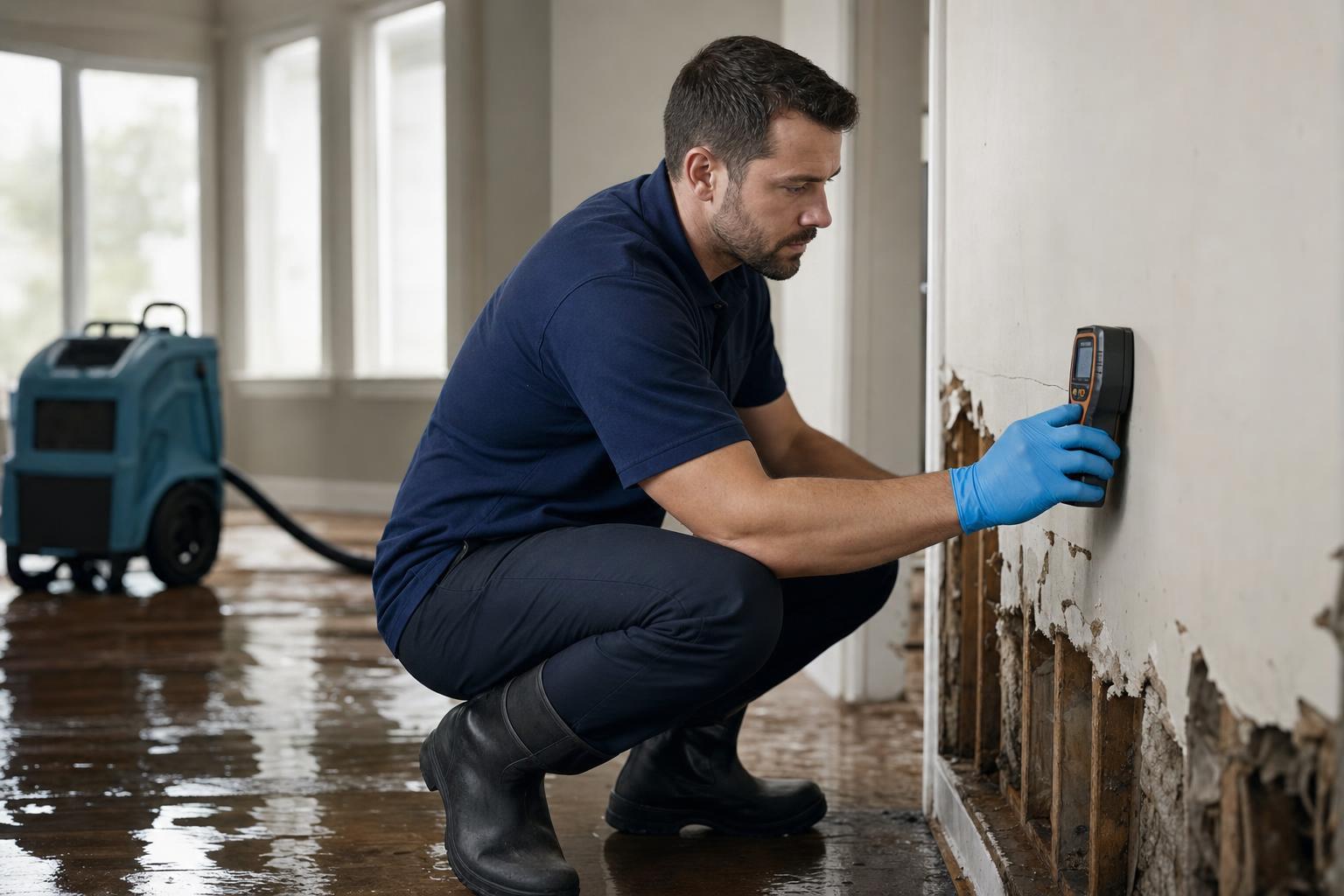
Lesson 4: Inspection, Moisture Mapping, and Instruments
You cannot remediate what you have not found, and mold hides. The visible stain is the smoke; the fire is the moisture and the growth inside the assembly. A disciplined inspection defines the true extent of both, sets the dry targets you will work toward, and creates the baseline every later reading is measured against. Rushing it produces under-scoped jobs, missed pockets that regrow, and clearance failures.
- 5
Lesson 5: Containment, Negative Pressure, and HEPA Filtration
Containment, negative pressure, and HEPA filtration are the engineering system that keeps a remediation from becoming a whole-house contamination event. Each part depends on the others: the enclosure defines the space, the filtration cleans the air inside it, and the pressure differential guarantees that whatever leaks, leaks inward.
- 6
Lesson 6: Source Removal and Material-Handling Decisions
Removal is where the plan meets the wall, and it runs on one governing principle: porous materials that are contaminated cannot be reliably cleaned, so they come out, while the goal on everything else is physical removal of the growth — not killing it in place. Get that principle right and most decisions follow.
- 7
Lesson 7: Moisture Correction, Drying, and Monitoring
Remediation that removes growth but leaves the water behind is a countdown, not a cure — mold returns wherever moisture and organic material meet again. So correcting the moisture is not a follow-up task; it is the part of the job that determines whether your work lasts. Two things have to happen: the structure has to be dried to standard, and the underlying source has to be fixed for good.
- 8
Lesson 8: Clearance, Verification, and Documentation
Clearance is the moment the job is declared successful — the affected area returned to a normal, healthy fungal condition — and it is the one judgment you should not make about your own work. Best practice, and law in some places, is independent verification: an indoor environmental professional inspects and tests, so the party who did the removal is not also the party who grades it. Your job is to prepare the area and the documentation so clearance passes the first time.
Curriculum
What you’ll learn
- Build full and partial containment with poly barriers, decontamination chambers, and sealed openings to prevent cross-contamination.
- Size, deploy, and balance HEPA air scrubbers and negative-air machines to hold proper pressure differential within the work area.
- Verify and document negative pressure using a manometer so containment integrity is provable on every job.
- Select and use HEPA vacuums, antimicrobials, and abrasive or media methods to remove growth from porous and non-porous materials.
- Find and fix the root moisture source — leaks, condensation, and high humidity — so growth does not return.
- Use moisture meters, hygrometers, and thermo-hygrometers to confirm materials and air are dried to acceptable conditions.
- Stage worker protection and decontamination, including respirator selection, PPE, and waste bagging, to meet exposure controls.
- Prepare the area and documentation for third-party clearance testing and interpret pass/fail criteria against the remediation protocol.
What's included
Everything you get with enrollment
One price — the course, the exam, the certificate, and the tools to put it to work.
Self-paced lessons
Guided lessons with key points, safety callouts, real job scenarios, and practice checks — about 2–3 focused hours.
A real certification exam
A 20-question exam drawn from a larger question pool — 75% to pass, and every retry gets fresh questions.
Professional field documents
Branded checklists, customer agreements, and job logs printed with your company letterhead — unlocked when you pass.
Instant, verifiable certificate
Pass and download your Certificate of Completion the same day — with a unique ID anyone can confirm online.
2-year validity + renewal
Your credential is valid for two years, with a simple renewal path before it expires.
Free Find-a-Pro listing
Once certified, claim a free listing so homeowners in your area can hire you.
The process
How it works
Enroll & pay
Secure checkout, instant course access.
Complete the course + pass the exam
Guided lessons with real job scenarios, then a 20-question exam — 75% to pass, unlimited retries.
Download your certificate
Personalized certificate generated instantly, with a unique verification ID.
Your credential
Your certificate
- Holder name and course title
- Unique certificate ID
- Issue date and expiry date (2-year validity)
- Online verification by ID
A NISCR Certificate of Completion confirms completion of NISCR training and examination. It is a professional credential, not a government license. Where local law requires a license to perform a service, the technician is responsible for obtaining it.
Certificate
of Completion
This certifies that
Your Name
has completed
Mold Remediation
- Certificate No.
- Valid
- NISCR-MRT-2026-XXXXXX
- 2 years
Enroll
Enroll today
$199
Course + certificate + a simple renewal option.
Try it risk-free for 3 days — full refund before you begin the final exam.
Better value
This course is part of the Water Damage Bundle — 4 certifications for $640 $796 (save $156).
View the bundle →Keep going
Related certifications
Questions
Frequently asked questions
- Is this a license?
- No. This is a professional certification, not a government-issued license. It verifies that you understand and can apply the standards-based process for mold remediation. Some states and municipalities separately require an occupational license to perform the work — this credential complements that requirement, it does not replace it.
- How fast do I get the certificate?
- The same day. Once you complete the course and pass the exam — a 20-question exam drawn from a larger question pool, with a 75% pass mark and unlimited retries, where each retry draws a fresh set of questions — your certificate is issued immediately so you can present it to customers, carriers, and the professionals who write your remediation protocols.
- Does my state require a license for this work?
- It varies. Several states and cities license or register mold remediation contractors, and some require an indoor environmental professional to write the protocol and perform clearance. Always check your state and local requirements before bidding. This certification complements those rules but does not replace a required license.
- Do I need to understand mold testing and clearance to take this course?
- You don't need prior testing experience. The course covers how clearance verification works and what an independent test checks for, so you can prepare the work area and your documentation to pass. In most jurisdictions the remediator and the clearance tester should be separate parties to avoid a conflict of interest.
- What equipment does this prepare me to use?
- The standards-based gear of the trade: HEPA air scrubbers and negative-air machines, manometers for pressure verification, HEPA vacuums, containment poly and decontamination chambers, moisture meters and hygrometers, and the respirators and PPE required for safe removal.
- Will insurers or property managers require a specific credential?
- Requirements vary. Some insurance programs and restoration networks require a specific industry credential; NISCR's Certificate of Completion is independent and does not replace one where it is required. What it gives you is documented, verifiable training and job documents you can show customers, including records of each step from containment through clearance.