Track A · BTC
Biohazard & Trauma Scene Cleanup Certification
The NISCR Biohazard & Trauma Scene Cleanup Certification is a $249 online, self-paced course — 8 lessons (≈2.5 hours) with a 20-question exam; pass and download a verifiable certificate the same day, valid 2 years.
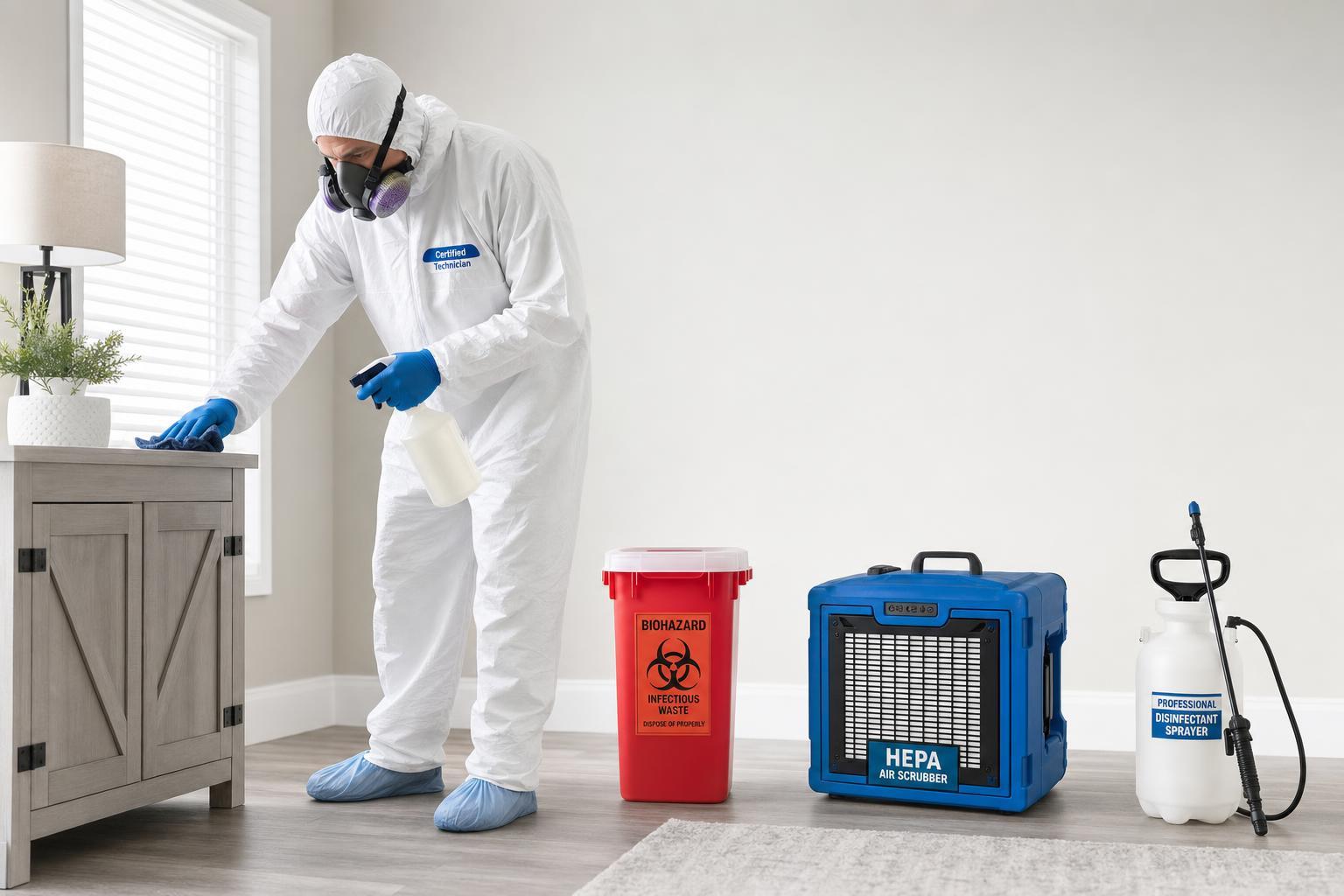
Master the disciplined, safety-first process for cleaning and decontaminating biohazard and trauma scenes — bloodborne-pathogen control, containment, recognized disinfectants used per label, and manifested waste disposal — and back it with a certificate anyone can verify online.
- Self-paced
- Instant certificate
- 2-year validity
- Format
- Online, self-paced
- Lessons
- 8 lessons
- Time
- ≈2.5 hours
- Exam
- 20 questions
- Pass mark
- 75% · retries
- Documents
- 3 included
- Certificate
- Same day
- Validity
- 2 years
Earning potential
How much can you earn?
Per-scene ticket
Varies by market
Margins on decontamination work
Varies by market
Owner potential
Varies by market
Illustrative ranges — actual earnings vary by location, effort, and experience, and are not guaranteed.
Why it pays
Why get certified?
Add a specialized service line
Few technicians will do this work, and fewer do it correctly. Documented, standards-based training in bloodborne-pathogen control and decontamination, backed by a certificate anyone can verify, gives you something concrete to show property managers and other clients.
Protect yourself and everyone downstream
Knowing PPE selection, containment, and a disciplined decontamination sequence keeps pathogens off you, out of clean areas, and out of the waste stream — the difference between a safe job and an exposure incident.
Show clients what they are paying for
A documented, standards-based scope with manifested waste disposal shows clients they are paying for safe work and proper disposal, not a bucket and bleach.
Keep a clear record of every job
Following recognized practice for pathogen control and waste handling, and keeping chain-of-custody records, helps you document your work if a job is ever questioned.
Curriculum
Inside the Biohazard & Trauma Scene Cleanup course
8 self-paced lessons, then a 20-question exam — 75% to pass, unlimited retries. Exam questions are drawn from a larger question pool, so every retry gets a fresh set.
- 1
Lesson 1: Bloodborne Pathogens and Universal Precautions
Biohazard and trauma cleanup begins with a single governing idea: you cannot tell by looking whether blood or body fluid carries an infectious agent, so you treat all of it as if it does. That principle — universal precautions, sometimes called standard precautions — is the foundation every other decision on the job rests on. Get it wrong and no amount of equipment protects you; get it right and the work becomes methodical and manageable.
- 2
Lesson 2: Personal Protective Equipment — Selection, Donning, and Doffing
PPE is the barrier between you and everything the scene contains, but it only works if it is the right gear, worn correctly, and — this is the part beginners underestimate — removed without contaminating yourself. On a biohazard scene, more exposures happen during doffing than during the work itself, because taking off soiled gear is where contamination gets transferred to skin. Treat donning and doffing as skills, not afterthoughts.
- 3
Lesson 3: Containment and Control Zones
A biohazard scene is a source of contamination that will spread if you let it — on boots, on tools, on a dropped bag, on your own gloved hand reaching for a doorknob. Containment is the discipline of drawing clear lines around the contamination and enforcing them, so the hazard stays where it is and the rest of the building stays clean. Without it, a cleanup can leave a property more contaminated than it started.
- 4
Lesson 4: Cleaning and Disinfection — Doing It in the Right Order
Cleaning and disinfection are two different jobs, and confusing them is the most common technical mistake in this trade. Cleaning physically removes soil, organic matter, and gross contamination from a surface. Disinfection uses a chemical to kill or inactivate the microorganisms that remain. The order is not interchangeable: you clean first, then disinfect — because a disinfectant applied over blood, tissue, or grime is largely wasted. Organic matter shields microorganisms and can neutralize the chemical before it does its job. Every effective protocol is clean-then-disinfect, in that sequence, every time.
- 5
Lesson 5: Porous vs. Non-Porous Materials and Sharps Handling
One judgment shapes the scope of nearly every biohazard job: what can be cleaned and kept, and what must be removed and discarded. The line runs between non-porous and porous materials, and it is not negotiable, because it reflects a physical reality about where contamination goes and whether you can reach it.
- 6
Lesson 6: Regulated Waste Handling and Manifested Disposal
Everything you remove from a biohazard scene has to go somewhere, and 'the dumpster' is not the answer. Regulated biohazard waste — the blood-soaked materials, contaminated PPE, sharps, and cleaning debris a scene generates — is handled through a controlled disposal chain that ends at an approved treatment facility, with paperwork that proves where every container went. Getting this wrong is not a technical stumble; it is a regulatory and public-health failure that can carry serious consequences for you and your company.
- 7
Lesson 7: Compassion, Communication, and Professional Conduct
Almost every biohazard and trauma scene is also the worst day of someone's life. Behind the contamination is a death, an injury, an illness, or a crisis, and the people you meet are often in shock, grief, or fear. The technical work matters, but the human conduct around it is what families remember and what defines a professional in this trade. You are not just decontaminating a space; you are doing it in front of, or on behalf of, people in pain.
- 8
Lesson 8: Verification, Documentation, and Closing Out the Job
A biohazard job is finished when you can prove it is finished — not when the scene simply looks clean. The final phase turns careful work into a defensible record: verification that the decontamination was accomplished, documentation of everything you did, and a professional close-out with the customer. Two crews can decontaminate a scene equally well; the one with a complete file has proof, and the one without has only its word if a question ever arises.
Curriculum
What you’ll learn
- Recognize bloodborne and other biological hazards and apply universal precautions that treat all body fluids as potentially infectious.
- Select, don, and doff PPE — respirators, fluid-resistant suits, gloves, and eye protection — in the correct sequence to avoid self-contamination.
- Establish containment with control zones, wrapped pathways, and a decontamination corridor that keeps contamination from spreading to clean areas.
- Clean, then disinfect non-porous surfaces with recognized disinfectants used strictly per label, including the required contact time.
- Identify and remove porous, contaminated materials that cannot be reliably decontaminated, and handle sharps safely in rigid containers.
- Package, label, and stage regulated biohazard waste for manifested disposal through a licensed medical-waste hauler.
- Verify a scene is decontaminated and document the work with a defensible chain of custody from scene to disposal.
- Conduct yourself with compassion, discretion, and professionalism around families and others affected by a traumatic event.
What's included
Everything you get with enrollment
One price — the course, the exam, the certificate, and the tools to put it to work.
Self-paced lessons
Guided lessons with key points, safety callouts, real job scenarios, and practice checks — about 2–3 focused hours.
A real certification exam
A 20-question exam drawn from a larger question pool — 75% to pass, and every retry gets fresh questions.
Professional field documents
Branded checklists, customer agreements, and job logs printed with your company letterhead — unlocked when you pass.
Instant, verifiable certificate
Pass and download your Certificate of Completion the same day — with a unique ID anyone can confirm online.
2-year validity + renewal
Your credential is valid for two years, with a simple renewal path before it expires.
Free Find-a-Pro listing
Once certified, claim a free listing so homeowners in your area can hire you.
The process
How it works
Enroll & pay
Secure checkout, instant course access.
Complete the course + pass the exam
Guided lessons with real job scenarios, then a 20-question exam — 75% to pass, unlimited retries.
Download your certificate
Personalized certificate generated instantly, with a unique verification ID.
Your credential
Your certificate
- Holder name and course title
- Unique certificate ID
- Issue date and expiry date (2-year validity)
- Online verification by ID
A NISCR Certificate of Completion confirms completion of NISCR training and examination. It is a professional credential, not a government license. Where local law requires a license to perform a service, the technician is responsible for obtaining it.
Certificate
of Completion
This certifies that
Your Name
has completed
Biohazard & Trauma Scene Cleanup
- Certificate No.
- Valid
- NISCR-BTC-2026-XXXXXX
- 2 years
Enroll
Enroll today
$249
Course + certificate + a simple renewal option.
Try it risk-free for 3 days — full refund before you begin the final exam.
Keep going
Related certifications
Questions
Frequently asked questions
- Is this a license?
- No. A NISCR Certificate of Completion is a professional credential confirming you completed NISCR training and passed the examination. It is not a government license. Biohazard and trauma cleanup is regulated in many states and localities — through business licensing, waste-transport permits, and worker-protection rules — and you are responsible for meeting every requirement that applies where you operate. This certificate complements those requirements; it does not replace them.
- How fast do I get the certificate?
- The same day. Once you complete the course and pass the exam — a 20-question exam drawn from a larger question pool, with a 75% pass mark and unlimited retries, where each retry draws a fresh set of questions — your certificate is issued immediately so you can share it with clients.
- Does my state require a license or permit for this work?
- Often, yes. Many states and localities regulate biohazard cleanup businesses and require permits to transport regulated medical waste, and worker-protection rules govern exposure controls and training. Requirements vary widely, so always verify with your state and local authorities before bidding. This certification documents your training but does not replace any required license, permit, or registration.
- How is biohazard waste disposed of?
- Regulated biohazard waste is never placed in ordinary trash. It is packaged and labeled per the rules that apply to you, staged securely, and handed to a licensed medical-waste hauler who transports it to an approved treatment facility. The transfer is documented on a manifest that creates a chain of custody, so you can prove where the waste went. Sharps go into rigid, puncture-resistant containers, never loose bags.
- Do I need prior medical or restoration experience?
- No. The course starts with the fundamentals — how pathogens spread, universal precautions, and PPE — and builds a complete containment-to-disposal workflow, so newcomers gain practical knowledge while experienced restoration technicians can formalize and document a specialty they already touch.
- Is the course self-paced?
- Yes. The course is fully online and self-paced. Start, stop, and resume on any device, and complete it on your own schedule. Given the sensitive, safety-critical nature of the material, take the time you need to absorb the pathogen-control and disposal sections thoroughly.