Hawaii · HSC
HVAC System Cleaning Certification in Hawaii
Complete NISCR's online, self-paced HVAC System Cleaning (HSC) certification for Hawaii and earn a same-day certificate. Deep cleaning of coils, blowers, and air handlers keeps systems efficient and air healthy, which is especially important in Hawaii where salt air, humidity, and vog accelerate buildup and corrosion.
100% online & self-paced — your certificate the same day, anywhere in Hawaii.
- Self-paced
- Instant certificate
- 2-year validity
Licensing
Do you need a license in Hawaii?
Cleaning HVAC components is often considered maintenance, but in Hawaii, working on, repairing, or modifying HVAC and mechanical equipment can require an HVAC or mechanical contractor license. Because the line between cleaning and regulated mechanical work matters, verify current requirements with the Hawaii Contractors License Board before performing this work. The NISCR certificate is a professional credential, not a government license.
| Government license | Professional certification (NISCR) | |
|---|---|---|
| What it is | Legal permission from a state agency to perform regulated work. | Proof you completed standards-based training and passed an exam — a verifiable certificate anyone can check at niscr.com/verify. |
| Who issues it | Your state licensing board or agency. | NISCR — a private certification provider, not a government body. |
| Legally required to work? | Sometimes — it depends on your state and the specific service. | No — it is a professional credential, not a legal requirement. |
| Why it matters | Required by law where it applies; operating without one can mean fines or penalties. | Verifiable proof of training that builds customer confidence and helps you compete for better-paying jobs; it does not replace a credential a specific insurance program requires. |
| How you get it | Apply through your state; requirements and timelines vary. | 100% online and self-paced — download your certificate the same day. |
A NISCR Certificate of Completion confirms completion of NISCR training and examination. It is a professional credential, not a government license. Where local law requires a license to perform a service, the technician is responsible for obtaining it. Licensing rules change and vary by city and county. Always confirm current requirements with your state licensing board before performing work.
Local demand
The hvac system cleaning market in Hawaii
Hawaii's marine environment is hard on HVAC systems: salt air corrodes coils, high humidity feeds microbial growth, and Big Island vog leaves residue, all of which reduce efficiency and air quality. With air conditioning common in hotels, condos, and homes across hot leeward areas, system cleaning is in real demand year-round.
Earning potential
What hvac system cleaning pros earn in Hawaii
HVAC system cleaning technicians in Hawaii often see illustrative pay from the low $20s into the high $30s per hour, with licensed mechanical professionals earning more. Pay depends on island, credentials, and employer and is not guaranteed.
Per-job ticket
$350–800
Add-on coil + blower service
$150–400 / unit
Commercial contracts
recurring monthly/quarterly revenue
Illustrative ranges — actual earnings vary by location, effort, and experience, and are not guaranteed.
Curriculum
What you’ll learn
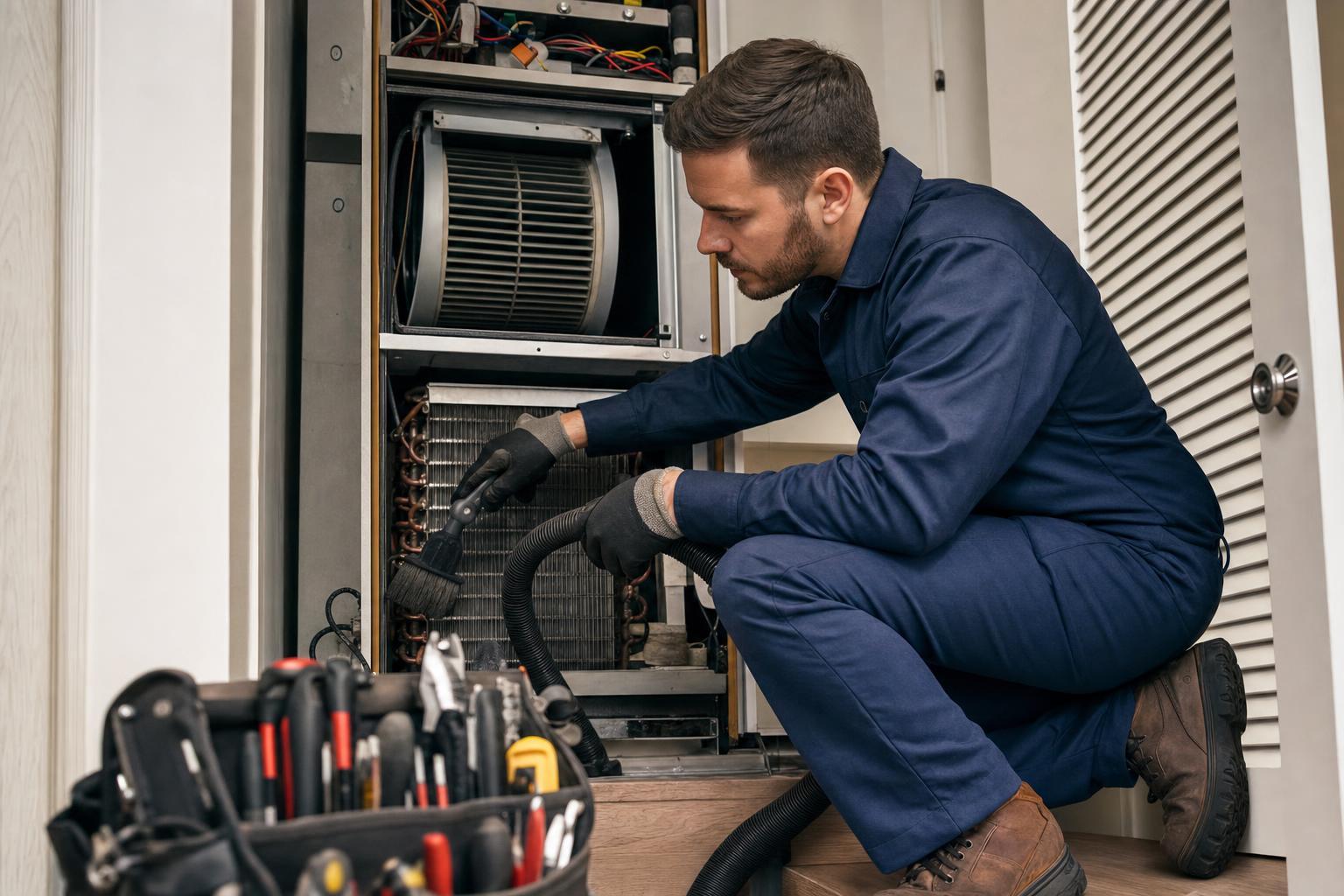
- Clean and rinse evaporator and condenser coils without bending fins or damaging the coil, using the correct foaming and no-rinse cleaners for each coil type.
- Disassemble, clean, and rebalance blower wheels and motor assemblies to remove caked debris that chokes airflow and wastes energy.
- Service condensate drain pans and lines — clearing clogs, treating biofilm, and verifying proper slope and drainage to prevent overflow and microbial growth.
- Open, inspect, and clean air-handler interiors and plenums, including interior insulation surfaces, following containment and source-removal standards.
- Set up negative-air containment and HEPA collection so dislodged debris is captured rather than spread through the occupied space.
- Identify and document microbial contamination, biofilm, and rust, and know when to refer remediation beyond routine cleaning.
The process
How it works
Enroll & pay
Secure checkout, instant course access.
Complete the course + pass the exam
Guided lessons with real job scenarios, then a 20-question exam — 75% to pass, unlimited retries.
Download your certificate
Personalized certificate generated instantly, with a unique verification ID.
Questions
HVAC System Cleaning certification in Hawaii — FAQ
- Do I need a license to clean HVAC systems in Hawaii?
- Basic cleaning may be considered maintenance, but repairing or modifying HVAC equipment can require an HVAC or mechanical license in Hawaii. Verify current requirements with the Contractors License Board before working.
- Is there demand for HVAC system cleaning in Hawaii?
- Yes. Salt air, humidity, and vog degrade systems quickly, and widespread air conditioning in hot leeward and tourism areas keeps cleaning work busy.
- Is the NISCR HSC certificate a license?
- No. It is a professional credential and does not replace any HVAC or mechanical license your work may require.
Nearby